



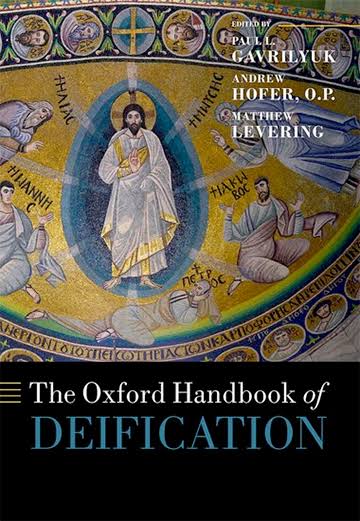
Witness Lee affirmed the patristic notion of salvation as deification, which is all the rage these days, as evidenced by the massive publication event of the Oxford Handbook of Deification (2024), with a whopping 44 chapters by leading scholars in the field.1 Lee grounded this claim, not surprisingly, in the Bible (especially John 1:12-13 and 2 Peter 1:4), but he repeatedly garnished it with Athanasius, who gave us the classic axiom: “He became man so that we might become God.”2
Lee adopted the Athanasian formula but modified it in one respect: he added the clause “in life and nature but not in the Godhead” to make it absolutely clear that there always remains a boundary and limit to our participation in God that the creature does not transgress, i.e., there always remains an ontological divide. The point is crucial and is characteristic of all orthodox theologians who affirm deification.3
The Critic
Recently someone responded to a comment I made about Lee’s affirmation of deification:
If you want to defend Lee’s doctrine, explain his famous analogy: “Dog begets dog, man begets man, therefore God begets God.” What logic justifies applying the biological reproduction principles of creatures directly to the uncreated Creator?
In this post I will respond to this comment with seven points.
My Response
1.
The commenter is right that Lee certainly used this example. Here is one instance of it:
When we become children of God, we have God’s life and nature. Since goats beget goats and cows beget cows, surely God begets gods… That which is begotten must be the same as its begetter. God’s heart’s intent is to make us the same as He is that we may be exactly like Him not only in the inward image and the outward likeness but also in His life and nature.4
Three things to notice here: 1) Lee is talking about becoming children of God, a biblical truth (e.g., John 1:12), and from this he draws out the implications that a child has the same life/nature as the parent, which is wholly in line with the rest of the biblical witness (John 3:16; 2 Pet 1:4). 2) He then invokes the classic Aristotelian notion that like begets like: “the begetter is of the same kind as the begotten.”5 He literally quotes it, just with the terms inverted. 3) He sees no reduction in meaning when seemingly downgrading to the language of “becoming like God.” This phrase is conceptually equivalent to the more robust term deification, for it is subsumed under the latter.
So to be begotten of God then is a biblical phrase that means to receive God’s life, share in God’s nature, and be like God in these ways.
2.
But the commenter gets two things wrong about the quote.
First, the punch line is actually “God begets gods,” i.e., lowercase6 and plural, which already grammatically signals some sort of conceptual distinction between the two terms: only God is God in a proper and unique sense. Second, Lee never used “therefore,” as it is used above—as if the biological facts determines the logic of God’s relation to us. Rather, it is the case that God reveals in Scripture that his relation to the redeemed is conceivable under the aspect of producing offspring.
Lee is not constructing a syllogism that begins with animal reproduction and deduces something previously unknown about God. He begins with the biblical assertion that believers are “begotten of God” and uses natural generation analogically to illustrate what begetting signifies: the communication of life and nature from begetter to begotten. Biology is therefore not the premise from which deification is deduced; it is the analogy by which regeneration is illustrated. And because the language is analogical rather than univocal, the manner of divine begetting cannot simply be identified with the manner of creaturely generation.
The commenter has reversed the direction and basis of Lee’s reasoning.
3.
When Lee does use this analogy, he often includes a number of qualifications. For instance, he says:
We do not share in the divine Godhead.7
It is a great heresy to say that we are made like God in His Godhead.8
We are not the same as God in the person of God.9
There is still a distinction between them and God.10
In a family… The children of the father do not have his fatherhood… In the same way, God is our unique Father; only He has the divine fatherhood.11
To avoid theological misunderstanding, it may be better to say that as children of God, we are God-men in the divine species.12
We may use the word deification in a limited sense to convey the fact that we have been born of God to become sons of God.13
These qualifications establish the limits within which Lee intends the analogy to operate. “God begets gods” does not mean that God’s children become additional members of the Godhead, become numerically identical with God, become self-existent, or that the Creator-creature distinction is erased. The analogy concerns what Lee calls God’s communicable “life and nature,” not God’s incommunicable Godhead. Lee’s “in life and nature but not in the Godhead” functions as the equivalent to the patristic becoming God by grace (in life and in nature) but not by nature (but not in the Godhead). For Lee, the Godhead is God’s unparticipatable essence and unique trihypostatic Person.14 In other words, Lee denies that in deification human beings ever breach and become the divine essence or ever become the Father, Son, or Holy Spirit.
4.
Calling the analogy “famous” is ambiguous. The analogy certainly is memorable and striking, but it is hardly central or pervasive in Lee’s corpus. By my count, Lee used it nine times across his 100,000 pages of printed ministry.15 With this in view, “famous” shouldn’t be taken to imply overweening or overbearing use, as if Lee brandished it like an upraised sword charging into battle, or as if he saw the analogy itself as a clincher to the argument, as if the truth of the matter rested on the example. And as I will show in point 7, it is not “his” analogy: he was not the first to use it.
5.
The analogy had an exegetical context. While it may seem a little crude or overly simplistic when detached from its context in his writings, it’s important to realize that the analogy arose from Scripture. Almost every time he uses the analogy (7 out of 9) he is discussing John 1:12-13, a passage on being born of God. The analogy didn’t float free with an independent logic, but was simply an example to illustrate the nature of regeneration: that birth communicates the life and nature of the parent to the offspring.
6.
The passage just mentioned has been identified by many theologians as a key text on deification. This identification of regeneration with deification is not peculiar to Lee, neither is the identification of this passages with deification. Andrew Byers, for instance, argues in his 2017 Cambridge monograph Ecclesiology and Theosis in the Gospel of John, that John 1:12-13 is “a deification text.”
This exchange and filiation result in a deification of the children of God because they are ontologically regenerated and accorded a divine status…
The exchange dynamic is clear: human believers become divine (1:12–13) because the divine Logos becomes human (1:14). Filiation and exchange… are foundational for later ideas of deification. Believers derive from a divine paternal source (plus a divine sphere, as the phrase ‘born from above’ indicates in 3:3) and participate within the social sphere of a divine family… Filiation involves deification in the Prologue because membership in this new family includes a divine re-origination ἐκ θεοῦ (‘out of God’) and a relational participation within a divine social entity… the point can now be made that this ecclesiology is one of filiation and theosis.16
Ancient writers make the same connection between John 1:12-13, becoming children of God, and deification.
Augustine says:
The grace of God came to you and ‘gave you the power to become the sons of God’ (John 1:12). Hear the voice of my Father saying, ‘I have said, you are gods and all of you children of the Most High’ (Ps. 82: 6)… If they are the sons of God, if they have been redeemed by the Saviour’s grace, if purchased with his precious blood, if born again of water and of the Spirit, if predestinated to the inheritance of heaven, then indeed they are children of God. And so thereby are gods.17
Pseudo-Dionysius says:
God in his love for humanity “has deigned to come down to us, and, by union with him which is like fire, to assimilate those things which have been unified according to their capacity for deification ‘For to all who received him he gave authority to become children of God, who believed in his name, who were born not of blood or of the will of the flesh, but of God’ (cf. John 1:12-13).18
Augustine, Pseudo-Dionysius, and Andrew Byers all agree with Lee that being begotten of God in John 1:12-13 means to become gods. They all agree that in regeneration God begets gods.
The “in regeneration” also signals that we are talking about not becoming GOD as God is God, for 1) we have to become this, whereas God is eternally, underivatively God in se, 2) regeneration is the application of God’s grace to our being, which means that we become God by grace, not by nature (ie we are not naturally God), and 3) since God regenerates, we only ever become God asymmetrically and dependently.
7.
The commenter calls it Lee’s analogy. But that’s really not the case. A number of theologians have used this EXACT example. And this is really important for evaluating Lee’s use of it.
In the following quotes notice both the general logic and the exact example that Lee employs. Some of these quotes establish what we can call “principle A”: generation communicates the nature/kind of the begetter. Others establish “principle B”: Christians are begotten/deified. Finally, some link A + B together and illustrate it just as Lee does. The Augustine and Lewis quotes are exact parallels to Lee.
Aristotle
That which generates is of the same kind as that which is generated—not however identical with it, nor numerically one with it, but formally one—e.g. in natural productions (for man begets man).19
Gospel of Philip (3rd century)
A horse begets a horse, a man begets man, a god begets god.20
This is from a Valentinian source. Its inclusion here is historical rather than normative, but it gives virtually the exact analogy under discussion.
Gregory of Nazianzus
It is in the nature of an offspring to have a nature identical with its parent’s.21
Augustine
Consider mortal and earthly creatures; what each thing is, is what it begets. A human being doesn’t beget an ox, a sheep doesn’t beget a dog, or a dog a sheep. Whatever the begetter is, that is what it begets… A mortal begets what he is, the immortal begets what he is; corruptible begets corruptible, incorruptible begets incorruptible; corruptible corruptly, incorruptible incorruptly.22
He who justifies is the same as he who deifies…if we have been made children of God, we have been made into gods.23
Cyril of Alexandria
Is not that which is truly the offspring of anything by nature manifestly of the same substance with the father of it? Is it not quite obvious to every one? The world then proceeds according to a suitable principle, for no creature produces anything different in kind from itself.24
Christ became one of us as Man, in order that we also might be like Him, that is, Gods and Sons.25
We are begotten of Him and in Him in the Spirit, to produce the fruits of life.26
Maximus the Confessor
Birth creates identity between the begetter and the begotten, which is why Scripture says that what is begotten of flesh is flesh, and what is begotten of the Spirit is spirit.27
C. S. Lewis
When you beget something, you beget something that is the same kind as yourself. A man begets human babies, and a beaver begets little beavers and a bird begets eggs that turn into little birds…. What God begets is God; just as what man begets is man…. What, then, is the difference which Christ has made to the whole human mass? It is just this… the business of becoming a son of God, of being turned from a created thing into a begotten thing…. He is beginning to turn you into the same kind of thing as Himself…. He said (in the Bible) that we were ‘gods’ and He is going to make good His words…. Century by century God has guided nature up to the point of producing creatures which can (if they will) be taken right out of nature, turned into ‘gods.’28
Conclusion
It should be obvious that Lee’s meaning and example are completely in line with and in fact identical to some of the most influential and respected theologians before him. These are not throwaway authors or minor leaguers—they are fundamental to how we do theology. In this sense, the criticism of Lee comes down to a misunderstanding or misinformation about patristic theology in general.
What seems to the critic like an embarrassingly simple or shockingly crude analogy turns out to be grounded in a solid philosophical principle and echoed by some of the greatest thinkers the church has ever seen.
- See the table of contents here for a glimpse of the sheer breadth of this publication. ↩︎
- Athanasius, On the Incarnation 54: αὐτὸς γὰρ ἐνηνθρώπησɛν, ἵνα ἡμɛῖς θɛοποιηθῶμɛν. ↩︎
- See for instance: Andrew Byers, Ecclesiology and Theosis in the Gospel of John (Cambridge University Press, 2017), 181: “In spite of the tremendous grace that relaxes the boundaries between divinity and mortality, an ontological gulf is still affirmed.” See also, Editors, Oxford Handbook of Deification (Oxford Uni Press, 2024), 5: “Deification is a process and goal by which the human being… comes to participate in God… while remaining a creature ontologically distinct from the Creator.” ↩︎
- Lee, CWWL 1994–1997, 3:376. ↩︎
- Aristotle, Metaphysics 7.8, 1033b 30-32. W.D. Ross’ translation. ↩︎
- Even if capitalized the distinction between God by nature and Gods by grace still holds. Maximus the Confessor, for instance, uses the capital ‘G’ when speaking of become God or Gods, and since we have the original his original Greek we can see that this is no mere English translation oversight, for the Greek Theos is also capitalized in these places. See, e.g., Amb. 7.12, 26, 31 and 20.2 ↩︎
- Lee, CWWL 1994–1997, 5:459-60. ↩︎
- Lee, CWWL 1991–1992, 2:463. ↩︎
- Lee, Life-study of First and Second Samuel (1993), 2. ↩︎
- Lee, Life-study of Jeremiah (1991), 184. ↩︎
- Lee, CWWL 1991–1992, 2:462-63. ↩︎
- Lee, CWWL 1994–1997, 5:333. ↩︎
- Lee, Life-study of Galatians, msg. 20, p. 175. ↩︎
- The last phrase is Sergei Bulgakov’s. ↩︎
- By my search, it only appears in these nine locations: CWWL 1991–1992, 2:462-63; CWWL 1993, 2:491; CWWL 1994–1997, 2:4-5; CWWL 1994–1997, 2:226; CWWL 1994–1997, 2:253; CWWL 1994–1997, 3:376; CWWL 1994–1997, 4:435-40; CWWL 1994–1997, 5:98; CWWL 1994–1997, 5:459-60. ↩︎
- Byers, Ecclesiology and Theosis in the Gospel of John, 183, 185. ↩︎
- Augustine, Sermon 81.6. ↩︎
- Psuedo-Dionysius, Ecclesiastical Hierarchy 2.2.1, 393А ↩︎
- Aristotle, Metaphysics 7.8, 1033b 30-32. ↩︎
- Gospel of Phillip 102, trans. R. McL. Wilson (A. R. Mowbray & Co, 1962), 51. For more info about this document see here. ↩︎
- Gregory of Nazianzus, Oration 29.10, p. 78. ↩︎
- Augustine, Sermon 398: On the Creed to the Catechumens 3, WA III/10, 447. ↩︎
- Augustine, Expositions of the Psalms, WA III/16, 381. ↩︎
- Cyril of Alexandria, Commentary on the Gospel of John, 10.2, on John 15:1. ↩︎
- Cyril, John 12.1, on John 20:27. ↩︎
- Ibid., ↩︎
- Maximus the Confessor, Ambiguum 10.20a, Dumbarton Oaks Medieval Library (Harvard Uni Press, 2014), 219. ↩︎
- C. S. Lewis, Mere Christianity (Touchstone, 1980), 138, 157, 164, 176, 188. ↩︎


I belong to a congregation which can be labeled as “Leeist”. From the 100,000 pages of Lee’s ministry, we accept and receive and practice everything and there are perhaps 2 or 3 minor points that we may have some preoccupation about. Real minor points though.
I compliment you for such a high caliber apologetic exposition concerning Lee’s “deification” teaching.
I just want to add a short comment related to our local experience in this small congregation.
We all know that since the sixties this is not the first issue in Lee’s ministry that brought controversy and misunderstandings.
On the one hand, we must admit that many Christians and theologians who denounced Lee on these questions as something not belonging to the Apostles’ Teachings, did it out of bad faith aiming to smear Lee’s ministry.
But, on the other hand, many beloved sincere word-loving Christians somehow found these teachings to be “a hard saying”.
Perhaps because they could not understand the whole context, or perhaps they could not grasp the meaning of “becoming God in life and nature but not in the deity”.
For the sake of these beloved brothers we decided to be more cautious on how we present this truth.
This does not mean that we changed our convictions or that we feel “ashamed” presenting what we believe in.
The only difference is that now we try to present it with words which are not too much “in your face”, giving a chance for the listeners to hear, think about, go back to the Bible, and eventually realize that what is being taught is the most pure word of the Holy Scriptures.
For this reason, instead of stating:
“He became man so that we might become God.”
We prefer to say:
“He became man so that we might become ‘like He is’”.
in reference to 1 John 3:2.
Later, if an opportunity arises, we would explain more precisely what the Bible teaches in this regard.
This way we hope that we are able to announce this important truth without causing anybody to stumble due to the complexity of the concept.
LikeLike
Pingback: God Begets Gods (2): Key Quotes | conversant faith