



The Recovery Version translates Revelation 1:1 like this:
The revelation of Jesus Christ which God gave to Him to show to His slaves the things that must quickly take place; and He made it known by signs (σημαίνω), sending it by His angel to His slave John.
“He made it known by signs” translates a single word in Greek. It is the verb form of the noun “sign,” which is where we get the English word semiotics. Semiotics is “the theory and study of signs and symbols, especially as elements of language or other systems of communication” (AHD). The noun form of the word is used, for instance, in Revelation 12:1.
A great sign (σημεῖον) was seen in heaven: a woman clothed with the sun, and the moon underneath her feet, and on her head a crown of twelve stars.
Revelation, like John’s Gospel, is clearly a book of signs,
showing how Christ is now caring for the church and how He is coming to judge and possess the earth and bring the church, His bride, into God’s full economy.1
The RcV translation tells its readers up front how to approach the revelation of Jesus Christ conveyed in John’s book—read with the glasses of spiritual interpretation on! Philo, the Jewish philosopher who was writing in the first century just before John, uses σημαίνω “with reference to the deeper signification of the OT.”2 Translating the Greek word as the RcV does at the start of the book helps prepare one for what is coming in the text. Of course, this is incredibly important to remember at the END of the book too, when we read of the New Jerusalem, which is not supposed to be taken as a physical city of pearly gates and literal golden streets, but a paramount sign of the consummation of God’s economy.
Other Translations
I’ve been in a number of Bible studies where I have said something like, “Revelation is a book of signs with spiritual significance. Take a look at the first verse.” People using the most popular English Bible translations will then flip over and read something like this:
The revelation from Jesus Christ, which God gave him to show his servants what must soon take place. He made it known by sending his angel to his servant John. (NIV)
Instead of “made it known by signs” we get simply “made it known.” No indication of signs. This translation goes back at least to the RSV (NT, 1946). The ASV (1901) still preserved the KJV’s “he sent and signified it by his angel.” DB Hart’s 2017 NT also adopts this rendering.
At this point in the Bible study people are looking at me skeptically, and ask “What translation are you using?” I tell them “the RcV.” “Never heard of it,” they say.
Encounters like this can lead readers to wonder whether the RcV is importing a theological interpretation into the translation itself. How could it not be if the ESV, NIV, NRSV, etc all differ from the RcV?
What’s going on here?
The RcV actually combines two approaches to this text—it expresses both the older and newer translation renderings. It essentially combines the KJV and the RSV approaches:
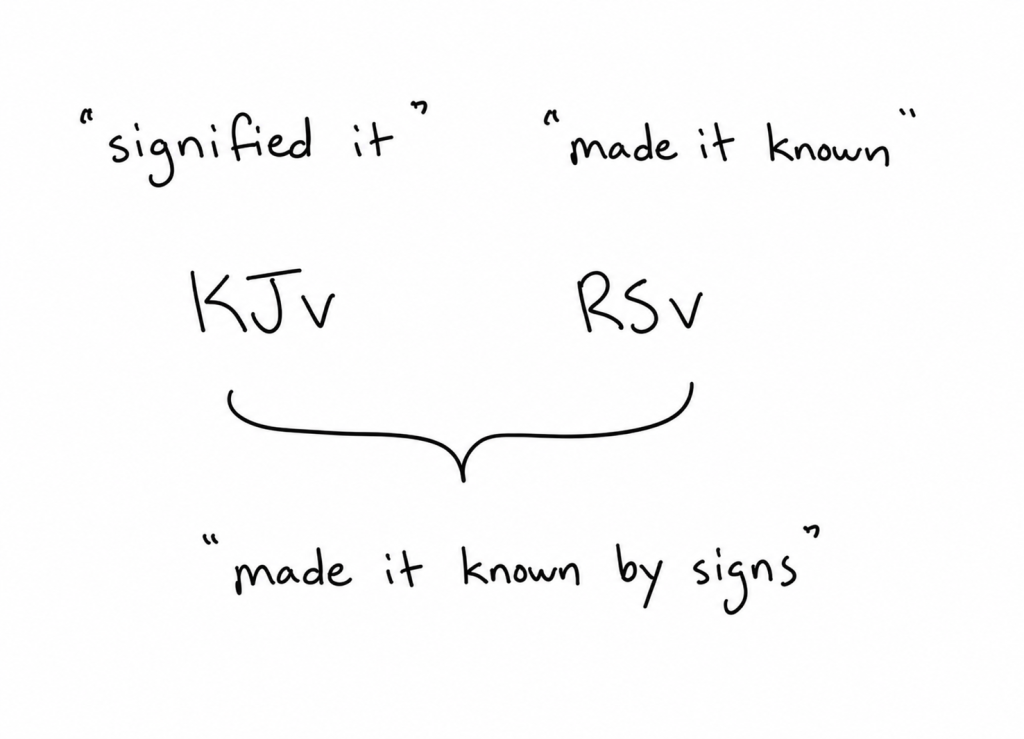
The benefit of the RcV approach is that it captures two key ideas:
- It tells you that the book of Revelation is a symbolic depiction of spiritual realities
- It tells you that, despite its symbolic character, it is still knowable (it was “made known”), ie all is not hopeless cryptograms!
To be fair, translations such as the NIV and ESV are not incorrect as far as possible Greek meanings go. The basic meaning of σημαίνω is “to make known” or “to indicate.” The question is whether, in this particular context, John intentionally chose a word that also evokes the language of signs. Many commentators think he did, especially given the symbolic character of the visions that follow.
Scholarly Support
While most English translations no longer retain the KJV’s “signified” (Hart is an exception) and no other version I know of offers the RcV’s “made it known by signs,” the RcV’s interpretation is supported by numerous commentators.
Robert H. Mounce, The Book of Revelation, NICNT (Wm. B. Eerdmans, 1977), 42.
The revelation is said to be “signified” (AV) to John. The Greek verb (sēmainō) carries the idea of figurative representation. Strictly speaking, it means to make known by some sort of sign. Thus it is admirably suited to the symbolic character of the book… It is important for an adequate understanding of Revelation to remember that God is communicating his message by means of visions that are symbolic rather than literal. What they portray exists in actuality, but the vision itself is simply the medium used by God to transmit that reality.
Buist M. Fanning, Revelation, Zondervan Exegetical Commentary on the NT (2020), 76
The lexical sense of this verb “made known” reflects an important dimension of the literary character of Revelation. This verb is often used in a more pedestrian sense of “to report, announce publicly” (e.g., Acts 11:28; 25:27), but it can take on the nuance of “signify, represent, make known through symbols” (cf. the cognate noun, “sign, symbol”). The latter sense for the verb is seen several times in John’s Gospel (12:33; 18:32; 21:19) where the noun also occurs in a distinctive way (a physical event with spiritual significance; John 2:11; 4:54; etc.). This richer meaning is seen also in Daniel 2:45 (“the great God has signified to the king what will happen in the last of the days,” referring both to the great statue in his dream and its end-time interpretation), a chapter that John seems to have in mind as he writes his prologue. John is thus previewing the abundant symbolism about God’s future for the world that characterizes his visions and this book that records them for the churches.
Stephen Smalley, The Revelation to John: A Commentary on the Greek Text of the Apocalypse (2005), 27-28
The word translated ‘made known’ in this text is characteristically Johannine (cf. John 12.33; 18.32). It derives from the root σημεῖον (semeion, ‘a sign’), which is the fourth evangelist’s term to describe the miracles of Jesus, the significance of which he is concerned to explain. So, in this setting, σημαίνω means more than ‘he indicated’; it has the force of ‘signifying’, or ‘disclosing’ deep truths. The seer will inevitably and consistently interpret the truth he receives symbolically.
John Christopher Thomas and Frank D. Macchia, Revelation, Two Horizons (2016), 74
The verb “showed” indicates the manner of the revelation here described, carrying with it the idea of prophetic and/or metaphoric language, as this verb comes from the same word family as the preferred Johannine word for “sign,” suggesting a meaning that has a significance that transcends a literal or surface meaning.
Peter Leithart, Revelation 1-11, ITC (2018), 81
ἐσήμανεν is worth consideration. God communicates to John and to the other slaves in signs and symbols. The apocalypse is not “plain speech.” The verb again links the apocalypse to the Gospel of John, where Jesus’s miracles are “signs” like the signs that Moses performed in Egypt, the signs and wonders by which Israel was redeemed, who also links John and Revelation on this point). John’s Gospel records the signs that Jesus began to do. Revelation records the signs that Jesus continued to perform after his exaltation.
Conclusion
The RcV’s rendering captures a dimension of the Greek verb that many commentators believe is important for understanding Revelation as a whole, again (like I showed in my last post too), despite what you might suspect by a cursory comparison with standard modern English translations. If more readers paid attention to the language of “signs” in Revelation 1:1, they might approach the book’s closing vision of The New Jerusalem with a greater appreciation for its incredible symbolic depth.


like many of your posts, very helpful. thanks
LikeLike
Thanks for reading!
LikeLike