


I wanted to add this quote from Karl Rahner to my last post on “what is the human?,” but it was already too long. Enjoy!
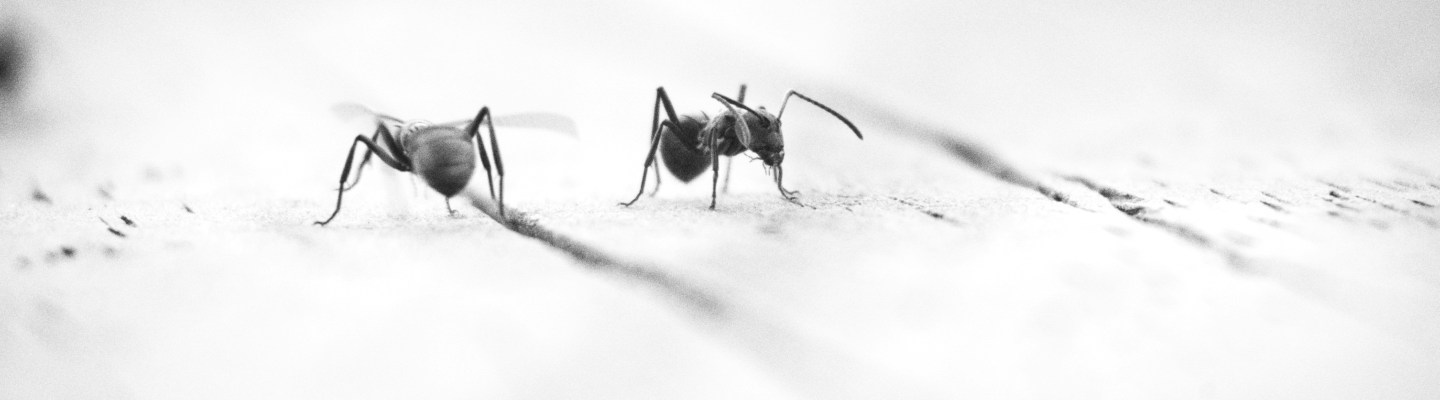
When we think of ourselves in relation to the universe, we seem like puny ants hauling a small pine needle a few inches at a time and considering this an important achievement without realizing how insignificant their laborious efforts are on the earth as a whole, which is itself only a tiny mote of a universe that extends over billions of light years and continues to expand in an enormous burst of energy. Viewed from this creaturely experience of our unim-portance, whatever we do or undergo, whatever we consider as happiness or fear as misfortune, all vanish into insignificance. Considered from a cosmic point of view, the most horrible thing that we might fear for all of humankind would be like a bit of friction in the enormous machinery of the universe. This might lead us to think that the whole history of humanity is basically nothing but a small, forlorn anthill in a universe that, among countless other things, has brought forth, incidentally as it were and quite indif-ferently, this three million years of human history to let it, after a brief time, wither away and die.
Yet the reality of the universe is in fact totally different from what this experience of our nothingness and forlornness in a cosmos ruthlessly going its way tries to make us believe. First, because this enormous power and energy that posits the cosmos in its reality and keeps unfolding it into an endlessly growing diversity is the most simple, most radical unity. This unity does not itself expand with the cosmos and thus disintegrate with it into multiplicity, but as one and as a whole, it is everywhere totally present at every point of the cosmos. This primordial power, which as an undivided totality subsists omnipotently everywhere at ever point, we call God.
However, this God, who in his entirety and omnipotence is present everywhere — even in the fir needle that the tiny ant is dragging along — has, in his power and overflowing love, freely decided to communicate himself, to insinuate himself entirely into this universe at a few seemingly forlorn points in it. Indeed, God has let this whole universe, in its apparently immeasurable and enormous size, come into being only so that the stage might be set for the occurrence of that divine self-communication to what is not divine, a self-communication that does not divide or scatter God, but bestows him entirely on the universe.
The points at which the universe is not only borne by God’s undergirding power, but at which God is received in his unity and totality, are called human persons.1
For Rahner then, to be human is to be the site of God’s deifying self-communication.
- Karl Rahner, “Book of God—Book of Human Beings,” in Theological Investigations XXII, trans. Joseph Donceel, S.J. (Crossroad, 1991), 215. ↩︎


I love this definition So poetic Good summary at the end too haha
LikeLike
Thanks!
LikeLike