



I have something like a taste for Karl Rahner, the modern Catholic theologian extraordinaire and so-called architect of Vatican II.
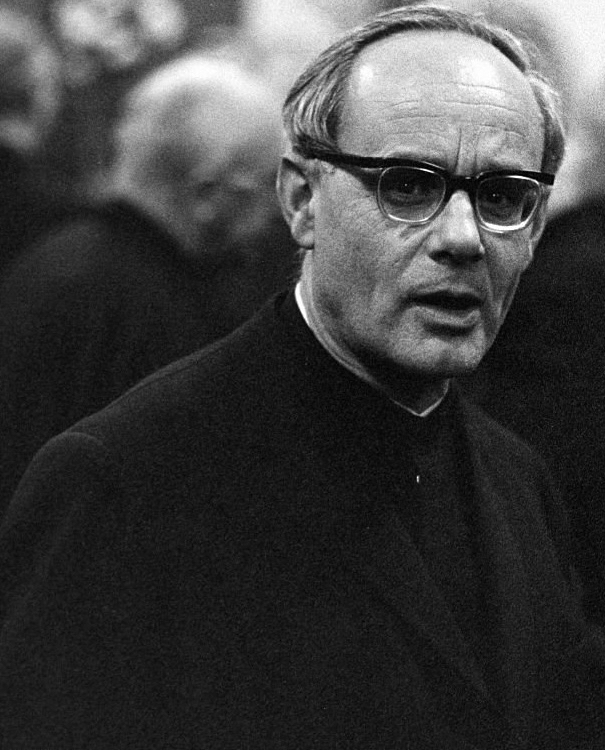
Don’t misunderstand me; it’s a taste—not a vital dependence, deep love, or fierce commitment. Rahner is not my bedrock or North Star. I’ve only read Rahner intermittently and haphazardly at this point, although always with interest and benefit. But as someone writing on Karl Barth, keeping abreast of him is a must, as modern theology in the 20th c. can largely be told as a tale of two Karls.
My taste for him is somewhat like a person who likes spicy food. A person who likes spicy food will always be down for a dash of Tapatio or slice of Serrano on whatever they’re eating. They see it as pure enhancement, an instant upgrade of flavor, or at least a way to make things interesting. Spiciness, however, has no nutritional value.
Similarly, I wouldn’t recommend an exclusive diet of Rahner (I doubt few would), but I do find much of his writings to be more than a tingle on the tongue. Much of it is profound, fascinating, and spiritually nutritious. And like spicy food, many of his insights linger on my theological palate long after the moment I’ve encountered them. He is stimulating, thought-provoking, and worth reading, even when I find myself disagreeing with him. All this to say, like the lover of spicy foods, I’m always up for some Rahnerian seasoning on my plate.
Rahner wrote tons and is notoriously dense at times. Karen Kilby, an expert on Rahner, says “in difficulty, if nothing else, Rahner is unsurpassed in the theology of the last few centuries.”1 Something being difficult is never a good reason not to undertake it. Quite the opposite is generally true. Either way, difficulty is not the only thing to be said about Rahner’s theology.
Why Read Karl Rahner?
Kilby recommends reading Rahner for his unusual combination of
- A powerful and intelligent speculative mind
- A strong pastoral sensibility and orientation
- A deep rootedness in Ignatian spirituality
Related to these second two points, scholars have argued that “One should read Rahner primarily as a practical theologian,”2 which is perhaps a shocker depending on where you have dipped in to Rahner. Even Rahner conceived of himself in this light. A practical theologian, in this case, is someone intensely interested in the lived experience of real people and their encounters with God and faith and how best to proclaim the gospel in ways that made sense to modern people.
These themes are evident in the prayers he composed. Many of these are collected in the book, Prayers for a Lifetime. This collection of prayers is not only beautiful and impressive, but practical and honest. Like getting in the kitchen with a chef and watching her work, prayers like this can help you learn how to pray, at least in one mode of prayer (remember Paul said “by means of ALL prayer” [Eph. 6:18] indicating prayer can be done in many ways).
Most of all, Rahner’s prayers teach us how a Christian might speak honestly before God and with confident candor. These are not frilly or overly-formal prayers, although they are certainly splendidly composed and often long. They are conversational, down-to-earth, and intimate.
The following prayer is a prime example of that. It is one I recently discovered and plan to return to often.
A Prayer of Sincerity Before God
Lord, look upon me, see my misery. To whom should I flee, if not to You? How could I tolerate myself, but for the thought that You can tolerate me, but for the knowledge that You are still my friend? Look upon my misery. Look upon Your servant who is lazy, headstrong and superficial. Look upon the meanness of my heart, which offers You only as much as is absolutely necessary and will not be generous in loving You. Look upon my prayers: see how sullenly and reluctantly I fulfill this duty and how cheerfully, for the most part, my heart turns from talking with You to other things. Look upon my work: it is barely satisfactory, extorted from me by the pressure of daily life, rarely prompted by true love of You. Listen to my words: the words of selfless kindness and love are rare. Look upon me, O God: You will see no great sinner, only a small one; one whose very sins are small, mean and commonplace; whose will and heart, mind and strength are mediocre in every respect, even in wickedness. But, my God, when I really reflect on this, I am greatly afraid. Surely the things I am forced to say of myself are precisely those which characterize the lukewarm heart? And have You not said that You prefer a cold heart to a lukewarm one? Is not my mediocrity the cloak behind which I hide the worst thing of all, in the hope that it will not be discovered: a selfish and cowardly heart, a dull and insensitive heart which knows no generosity of spirit nor breadth of mind?
Have pity on my poor heart, magnanimous and loving God, God of blessed abundance. Send Your Holy Spirit into my poor barren heart and refashion it. May Your Spirit burn deep into my dead heart with the fear of Your judgment and let my heart awaken! May Your Holy Spirit fill it with fear and trembling: let it shake off the deathly grip of hopelessness and resignation! May Your Spirit make my heart humble and contrite: let it be filled with longing for Your sanctity and with confidence in Your all-powerful grace! May Your Spirit fill my heart with the holy penitence which is the beginning of the heavenly life and with confidence in the invincible power of Your assistance, which brings courage and readiness, cheerfulness and boldness to the hearts which serve You.
Only if You give me Your grace, can I feel how much I need it. Only the gift of Your mercy makes me recognize and confess that I am a poor sinner. Only Your love gives me the courage to hate myself without despairing. You have had mercy on me, Holy God. Your Son has given His Body for me. This is why I can call upon Your mercy. He has tasted death, which is the wages of sin. This is why I need not despair in the sinful darkness of my life. I venerate the mystery which shows the death of the Lord until He comes. This is why I can be confident when the weakness of the flesh and of sin seems to crush me. Through Him who was crucified, all is changed: darkness into light, death into life, weakness into strength, emptiness and loneliness into fullness and closeness to You. Through that sacrament in which our crucified and risen Lord is truly present for me, I pray You, Eternal Father, I, a poor sinner, pray You, Father of Mercies and God of All Comfort: Have mercy on me, O God, according to the great fullness of Your mercy. And my poor heart will praise Your goodness for ever.3
Amen.
- Karen Kilby, Karl Rahner: Theology and Philosophy (Routledge, 2004), 1. ↩︎
- Elisabeth Schüssler Fiorenza, “Method in Theology,” in The Cambridge Companion to Karl Rahner (2005), 68. ↩︎
- Rahner, Prayers for a Lifetime, 6-8. ↩︎


Thanks for this piece. I tried adding a comment on WordPress but got lost in the password jungle. Here’s what I wrote as best I can remember it:
This is the honest prayer of a man, not a woman, and especially an intellectual. The existence of it proves the belief deep in the heart while the expression shows the battering that belief takes from the untransformed mind: “The fool has said in his heart, ‘There is no God.’” My view is there are no true atheists, there are just conquered hearts. In this man’s case, the heart is winning or at least holding its ground.
Mark Jordan
LikeLike
Pingback: Composed Prayer and All Prayer | conversant faith