That Ubiquitous Bible

In honor of the first week of classes at UT, I’m posting the intro to the Gideon pocket size Bible… that ubiquitous little Bible.

First the pertinent facts: they come slightly larger than an iPhone and in full technicolor. And did you know the colors are significant? I didn’t.

  • Orange: for sidewalk distribution to middle/high school students
  • Green: for college/university students
  • Red: for in-school distribution to Middle/High school students
  • Digital Camouflage/Desert Camouflage: for the military
  • Dark blue: for law enforcement personnel, firefighters, and EMTs
  • White: for medical professionals
  • Light blue: for distribution by the Auxiliary only
  • Brown: personal worker’s testaments (for individual witnessing by Gideons)
  • Periwinkle: personal worker’s testaments (for individual witnessing by the Auxiliary)

On the left are three of my copies, the first of which (red) I got on Oct 13, 1989, complete with dinosaur sticker inside the front cover. But lacking this intro.

If you haven’t ever read this, enjoy!

“The Bible contains the mind of God, the state of man, the way of salvation, the doom of sinners, and the happiness of believers. Its doctrines are holy, its precepts are binding, its histories are true, and its decisions immutable. Read it to be wise, believe it to be safe, and practice it to be holy. It contains light to direct you, food to support you, and comfort to cheer you. It is the traveler’s map, the pilgrim’s staff, the pilot’s compass, the soldier’s sword, and the Christian’s charter. Here paradise is restored, Heaven opened, and the gates of hell disclosed.

Christ is its grand subject, our good the design, and the glory of God its end. It should fill the memory, rule the heart, and guide the feet. Read it slowly, frequently, and prayerfully. It is a mine of wealth, a paradise of glory, and a river of pleasure. It is given you in life, will be opened at the judgment, and be remembered forever. It involves the highest responsibility, will reward the greatest labor, and will condemn all who trifle with its sacred contents.”

The Architectural Roots of Humanism (2)

Architecture is a powerful force.

It petrifies and lays down once and for all the movement of life. Form places provocations or limits on the use of space. Architecture is not merely a public service to provide an indoor environment for people to live and work. It is a philosophical statement about man.

The major difference between the Middle Ages and the Renaissance is their view of man. These views are reflected in their architecture.

A prominent abbot named Suger (he’s French, so sounds like soo-zhay) of St. Denis spearheaded a new philosophy near the middle of the 12th century, that challenged the Romanesque precedent of self-denial and austerity. This happened through his lux nova dogma and conception of “God is light.”

Gothic architecture was a technical response to a theological idea.

Continue reading

The Architectural Roots of Humanism (1)

Lying quiet in the shadow of the Hellenistic flourish a few centuries before Christ, when Rome appropriated the architecture of the Greek and Etruscan colonies, it was selective in its borrowings and adapted geometry to a new use: the active experience of space through the novelty of the arch.Then there was the dome, and all of the sudden Imperial Rome was heralding its grandeur through large scale, massive, state funded architecture.

Architecturally, the Renaissance was a looking back upon and a scrutinizing of Classical antiquity, with the realization that they had gotten something right.

Continue reading

When “Going to Church” was Coming Home

Act 2:46 – And day by day, continuing steadfastly with one accord in the temple and breaking bread from house to house, they partook of their food with exultation and simplicity of heart

This is a picture of the earliest discovered (231 AD) Christian home that was used for a meeting place. It was discovered in Syria and is called the Dura-Europos house church. The meeting area is on the left and the baptistery is on the right, toward the back.

I found this interesting quote from Spiro Kostof’s A History of Architecture:

“Indicative of a repressed and plebeian movement, the places of worship were exceedingly modest. Centers for the community were set up in remodeled, outwardly inconspicuous houses… To the first generations of believers the church was where the Christians were. The word ecclesia, “church,” signified the community of Christ that had no need for prescribed buildings to proclaim its faith and reaffirm its bonds. The people were the architecture. In the century or so before Constantine the random gathering places of this primitive Christianity slowly began to be formalized, and with the sudden breakthrough of the imperial conversion, the necessity of a monumental built order to project prestige and authority came to be recognized.”

The Bible at a Glance

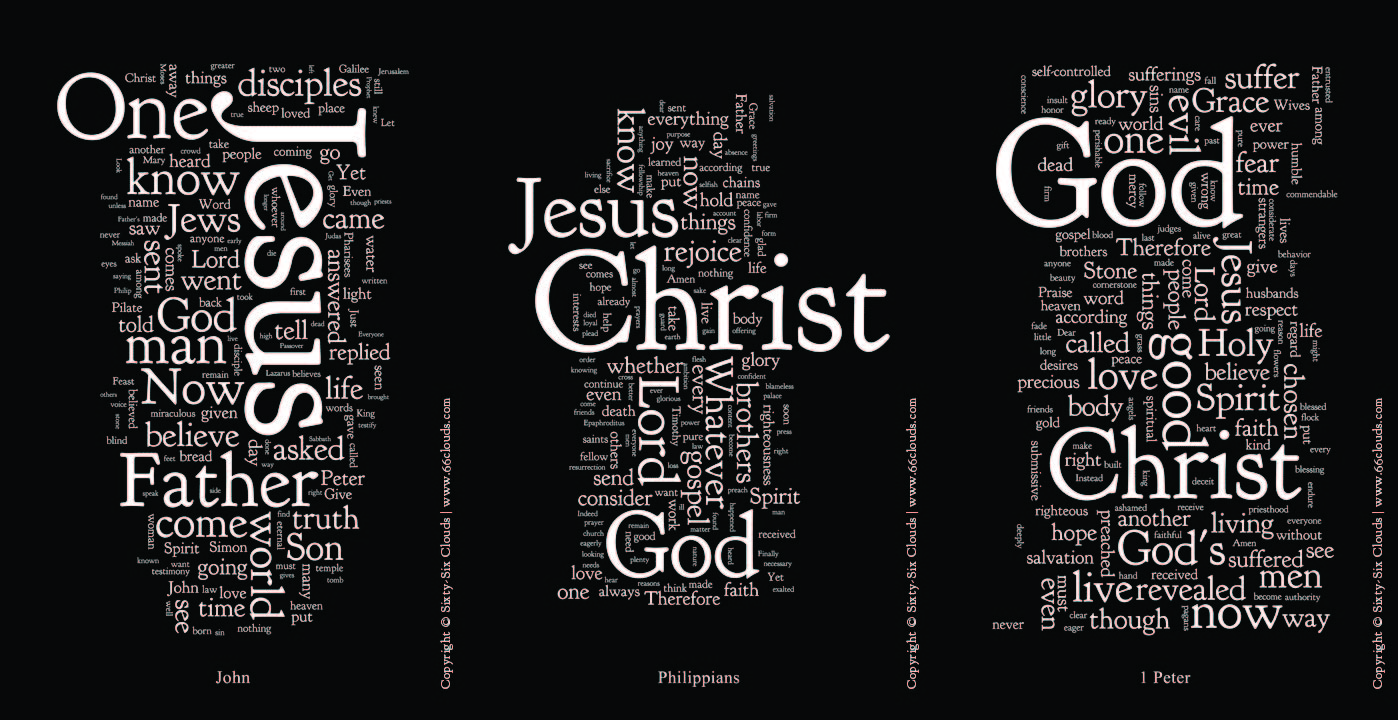
It’s called sixty-six clouds.

If the Bible was the collective blogging effort of men of old, this would be the tag cloud.

This is the ultimate word study turned graphic.

These 11″x17″ posters turn the words of the Bible into home decor. I call it decorative evangelism. Want to get an idea of what the Bible is all about? Scroll through these posters that visualize word frequency in the Bible and you’ll agree that the Bible is focused not on dry doctrines but on a living person!

Witness Lee was right when he said, “The early apostles, such as John, Paul, and Peter, although their style, terminology, utterance, certain aspects of their views, and the way they presented their teachings differed, participated in the same, unique ministry, the ministry of the New Testament. Such a ministry ministers to people, as its focus, the all-inclusive Christ as the embodiment of the Triune God.”

The three posters above, from the books John, Philippians, and 1 Peter demonstrate this. Paul, John, and Peter were the three major authors of the New Testament, writing from different backgrounds, with different perspectives, to different audiences, in different regions, at different times. And YET all their writings stress the Triune God for our experience.

Use the link above to check out the website! There’s a poster for every book in the Bible.

Live for Me

I saw a billboard last week as my wife and I were driving back to Texas. Not a unique or staggering experience, I know, but this one caught my eye. It read: “Live for Me, I died for you –God.”

As we flew past it at 70+ mph it managed, unlike other billboards, to lodge itself in my mind. And as we continued to drive along that spatially unassuming road in the middle of nowhere, that sign with those curated seven words, so poignantly chosen to sound right out of the ten commandments, rolled in the lock of mental undertow.

I realized you can read that sign one of two ways.

Most people probably read, “Live for Me, I died for you” with the traditional glasses of Christianity- doing things in honor of God or for the glory of God. To me, this concept is very vague but of course universally applicable. The thought is: if I recognize God for this gift or talent and do it as best I can He is glorified since He created me in this unique way.

Continue reading