When “Going to Church” was Coming Home

Act 2:46 – And day by day, continuing steadfastly with one accord in the temple and breaking bread from house to house, they partook of their food with exultation and simplicity of heart

This is a picture of the earliest discovered (231 AD) Christian home that was used for a meeting place. It was discovered in Syria and is called the Dura-Europos house church. The meeting area is on the left and the baptistery is on the right, toward the back.

I found this interesting quote from Spiro Kostof’s A History of Architecture:

“Indicative of a repressed and plebeian movement, the places of worship were exceedingly modest. Centers for the community were set up in remodeled, outwardly inconspicuous houses… To the first generations of believers the church was where the Christians were. The word ecclesia, “church,” signified the community of Christ that had no need for prescribed buildings to proclaim its faith and reaffirm its bonds. The people were the architecture. In the century or so before Constantine the random gathering places of this primitive Christianity slowly began to be formalized, and with the sudden breakthrough of the imperial conversion, the necessity of a monumental built order to project prestige and authority came to be recognized.”

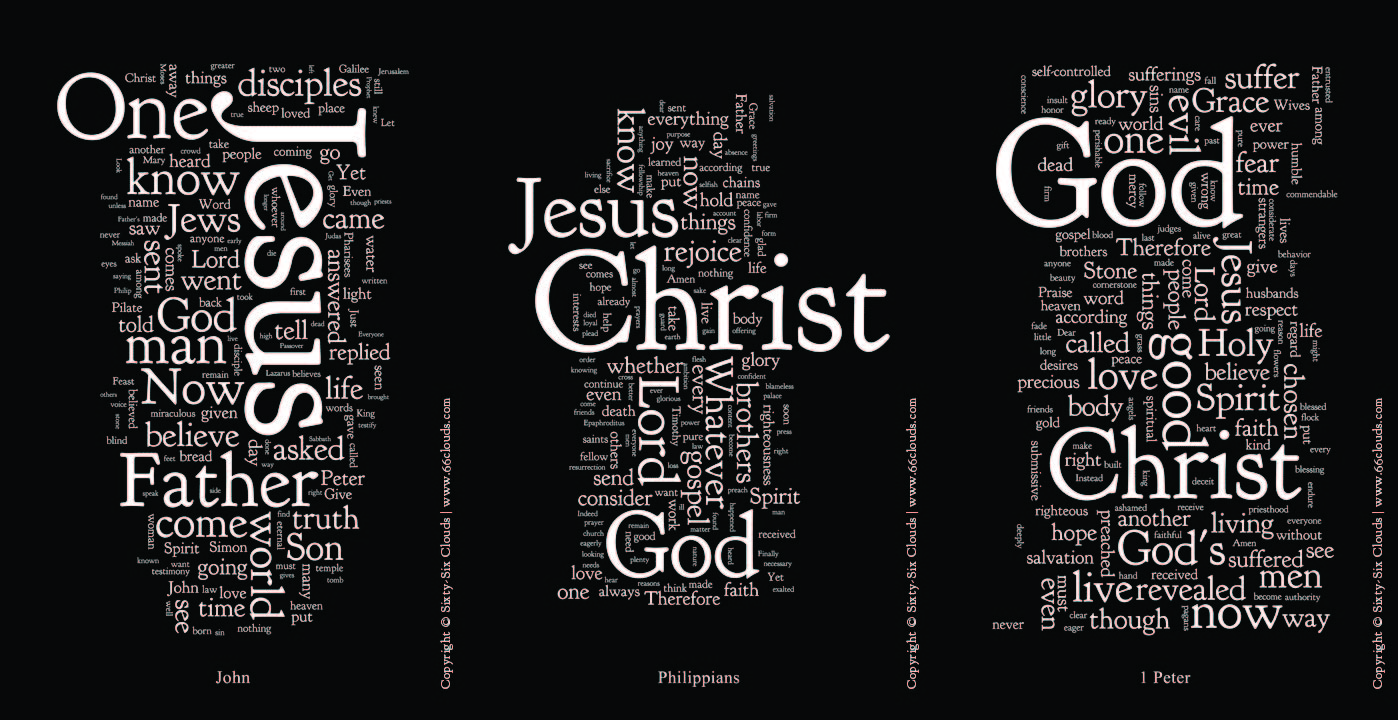
The Bible at a Glance

It’s called sixty-six clouds.

If the Bible was the collective blogging effort of men of old, this would be the tag cloud.

This is the ultimate word study turned graphic.

These 11″x17″ posters turn the words of the Bible into home decor. I call it decorative evangelism. Want to get an idea of what the Bible is all about? Scroll through these posters that visualize word frequency in the Bible and you’ll agree that the Bible is focused not on dry doctrines but on a living person!

Witness Lee was right when he said, “The early apostles, such as John, Paul, and Peter, although their style, terminology, utterance, certain aspects of their views, and the way they presented their teachings differed, participated in the same, unique ministry, the ministry of the New Testament. Such a ministry ministers to people, as its focus, the all-inclusive Christ as the embodiment of the Triune God.”

The three posters above, from the books John, Philippians, and 1 Peter demonstrate this. Paul, John, and Peter were the three major authors of the New Testament, writing from different backgrounds, with different perspectives, to different audiences, in different regions, at different times. And YET all their writings stress the Triune God for our experience.

Use the link above to check out the website! There’s a poster for every book in the Bible.