
We have of the universe only formless, fragmentary visions, which we complete by the association of arbitrary ideas, creative of dangerous suggestions.
–Marcel Proust
Author Archives: Kyle Barton

Regeneration and Continuing in the Really Life

Our experience of regeneration determines our subsequent experiences of life.
The experience of regeneration initiates something that continues for eternity. Regeneration orients us for the rest of our life and becomes the standard by which we evaluate all other life experiences. When we are awakened to what transpired within us at the time of our salvation, we begin to value “that which is really life.”
…lay hold on that which is really life. –1 Timothy 6:19
Regardless of how apparently real or contributory others’ lives are without Christ, they live in a psuedo reality, a virtual world. They may be successful. They may be an activist. Their life may tell a compelling narrative. Yet in God’s eyes none of it is real, in a relative sense. Yes, it actually happened, but it happened all in the realm of shadows- pointers to another reality in Christ (Colossians 2:17).
Regeneration is a point of embarkation. It confers on those who experience it a prize and an authority (Colossians 2:8, John 1:12-13). The prize- we become among those privileged to enjoy Christ as everything. The authority- we have the right to continue in this all encompassing experience until Christ is all to us. He is our food, drink, breath, clothing, house. This doesn’t mean that we withdraw from the physicality of existence and become a hermit or nun. It means that every life event becomes a dual experience. We eat our breakfast and are reminded to eat Christ (John 6:57). We take a deep breath and simultaneously maintain our spiritual life pulse by calling on the Lord’s name (Lamentations 3:55-56).
However, it’s possible as Christians to live outside of the continuing experience of our regeneration. We should not receive this new life and then remain in our old context with life as usual.
4 views on the experience of regeneration:
1. Remedial
You’re bad and need to have a change or improvement. This may be likened to having bad eyesight and getting corrective lenses. Regeneration then is a life-saver thrown to you in the sea of moral depravity. Regeneration is described as a washing but also as a birth. The cup is cleansed but also filled. This is the objective only view.
2. Transient
As long as you behave, do good works, and remain in God’s favor then this experience is yours. But just as it came, it could go. There’s no feeling of stability, power, or safety. This is the reversible birth concept.
3. Nostalgic
You have your ticket to heaven. You received everlasting life but plan to live a long life, maybe until 80, and then at the end when you need it, this life will kick in and cause you to live forever. This was an event in time past with no durative consequences. A distant moment of glory. Your come-to-Jesus moment. He came into your heart, but stays inert, the same, unchanging with passive indifference, like a lump of graphite embedded under the skin. Later you’ll say, let me recount to you my experience 20 years ago.
4. Dynamic
This is what I tried to describe at the start. Another life, Christ Himself, enters your spirit and begins a revolution. This life is not static or inert. It moves, grows, and transforms you from within. This life becomes a realm in which you conduct your existence. This life is incorporated into all your daily ventures so that your experience of what you received at the time of your regeneration is as real and vibrant years after. Everything becomes a reminder and an opportunity to continue in your experience of regeneration.
This fourth description makes for a compelling and exciting Christian life. Being Christian then is not boring, blasé, or dull. And it is not merely a new title we adopt to commemorate a one time experience. It is a progressive and expanding endeavor of experiencing the divine life that we received, all the time.
Related articles
Share this:

Watchman Nee Hymn
Watchman Nee’s hymns are some of the deepest and moving I have ever heard. I wish more believers today enjoyed not just his ministry of the word but also his wealth of hymns.
I recorded this on my iPhone in one sitting without looking at the number of stanzas, so please forgive the fact that I don’t play the whole thing through.
1. Lord, when the Father ne’er was known, / The Father came through Thee below,
That we who lived in ignorance / Might through Thyself the Father know.
Share this:


Why we don’t need to rebrand Christianity or reimagine church
 With the ongoing mudslide of many mega churches and the grassroots attempt to rebrand Christianity, many believers are focusing on Biblically external corrective measures for the church.
However, the survival of the Christian faith and believers living a society-impacting church life, historically, has not depended on professional marketing or hip adaptations of Christ’s teachings to make them more relevant. These have hurt more than helped.
God’s word has prevailed during the last 2,000 years because of its essence- spirit (John 6:63). God doesn’t need us to breathe fresh life into a failing institutional system. He wants us to breathe God in as the Spirit through His word. God gives the Spirit without measure.
Share this:

Ten Years Later
chords that are broken will vibrate once more
Share this:

On Language, the Bible, and Blog Posts

Although all humans share the creative use of language, it seems that not all of us are using it. Especially in today’s social-media saturated world, where the ephemeral nature of conversation is touted, the art of writing well or of producing something to be read at length is vanishing. This is most alarming to writers, but also to the rest of us who still want to communicate beyond chat boxes, text messages, or the 140 characters of a tweet.
Many people don’t actually read anymore, they scan. The difference is whether or not you are actively processing information and emotionally responding to it or whether you’re just getting an eye exercise out of the event.
In writing a blog you want to find some means to engage your reader. And if you are blogging about what really matters this is all the more important. Style, rhythm, vocabulary, syntax, metaphor are all part of the linguistic devices that can accomplish this. The goal is not to merely communicate information. This could be done more efficiently through bulleted lists, and it certainly would demand less of the reader. But there is something to the creative manipulation of words that is worth our effort.
Christ Himself in His eternal preexistence is the Logos or Word. The written Word of God came to us authored by God as a book, not as a neatly packaged creed or a logically ordered outline. Even truths such as justification or the nature of God are not collected altogether for our convenience. No book of the Bible is entitled, On Knowing God or The Basics of Salvation. The divine truths are scattered and hidden throughout all 66 books of the Bible like the pieces of a jigsaw puzzle, “here a little, there a little (Isaiah 28:10).”
Even the two original languages, Hebrew and Greek, that were employed to pen the Scriptures seem ordained by God.
The Old Testament is a figurative portrait of God’s eternal economy and the Hebrew language is perfectly suited to accomplish this. Hebrew is a pictorial language in which events are not merely described but verbally painted. It is vivid, concise, and simple and relies more on observation than reflection. With Psalm 23:1, English requires 9 words to translate the 4 Hebrew words. The entire chapter in Hebrew only contains 55 words, where as most English versions need 113.
The New Testaments is the practical fulfillment of God’s eternal economy as the caption under the picture, describing the reality, in Christ, of what was typified in the Old Testament, and Greek again fits the bill. The distinguishing characteristics of the Greek language are its strength, clarity, and richness. It is well suited for the doctrinal precision that elucidates the divine realities. For example, the definite article alone can inflect 24 different ways according to gender, number, and case. The result is loaded sentences that are tagged with lots of information to clarify what is being modified, referred to, who is doing the action, etc. Not much is left to guess work.
A great example is Ephesians 6:17,
And receive the helmet of salvation and the sword of the Spirit, which is the word of God.
Most people think the word of God here refers back to the sword, aka that the word of God is the sword. And people casually refer to the Bible as their sword, “Don’t come to church without your sword.” However, the Greek makes it clear that the relative pronoun ‘which’ refers to the Spirit. This means that the Spirit is the word of God! This understanding opens a whole vista of revelation. Thanks to Greek, this is possible.
If God took great care to communicate His eternal purpose to humanity through human language, we should at least strive for the same in ministering the word. I’m not advocating rigid, stuffy formalism or technical jargon. Just a healthy dose of encouragement to practice developing our skill to convey God’s word whether through conversation or blogging.
Kevin DeYoung had a great article recently on writing well for those blogging about the divine truths. Here’s a preview:
All of us appreciate good writing. We may not know that, and if we know that we probably don’t know why. But we all prefer to read something written well. There’s a way to communicate the truth and have it sound muddled. There’s a way to make it understandable. And then there’s a way to make it sing. That’s the difference between clear prose and great prose.
Share this:

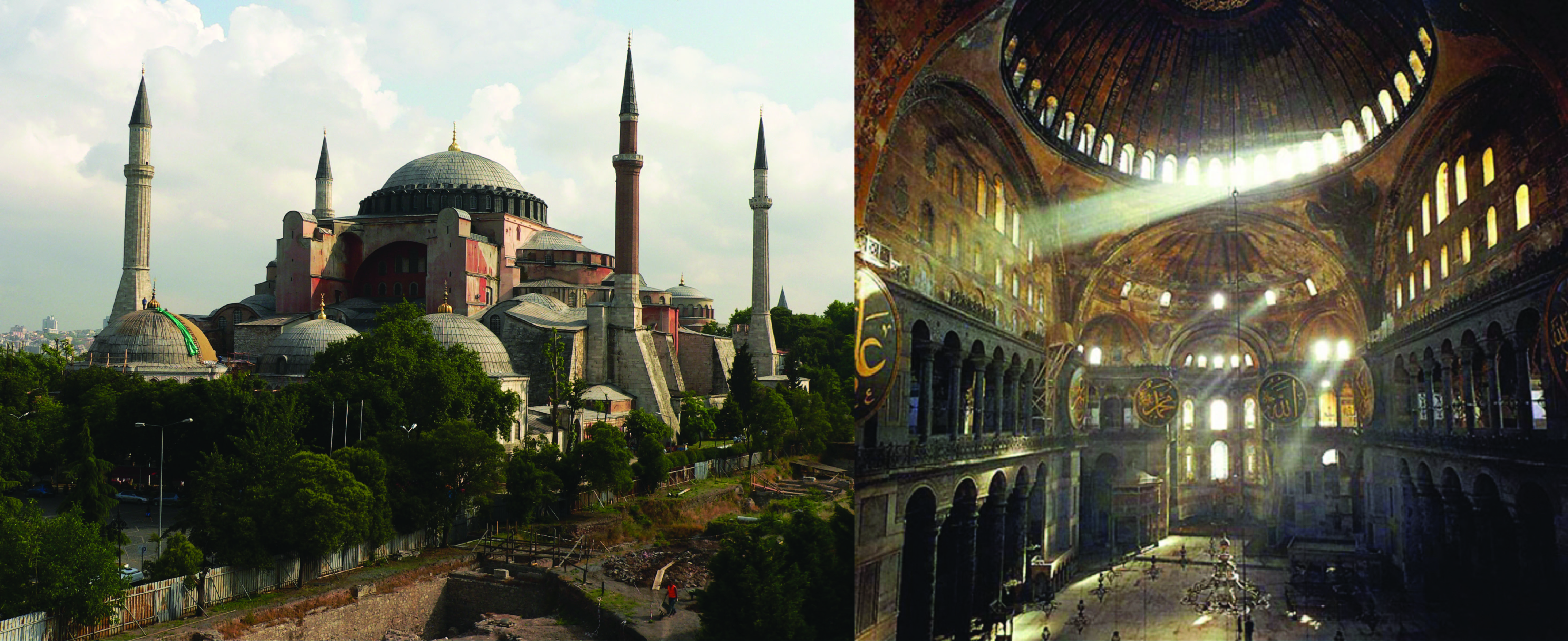
Hagia Sophia—what religious architecture fails to attain
“Because the God who said, Out of darkness light shall shine, is the One who shined in our hearts to illuminate the knowledge of the glory of God in the face of Jesus Christ.”
-2 Corinthians 4:6
I’ve been commenting here and there on how existential views of man or theological concepts have shaped religious building works. Architecture is very philosophical and theories abound as to why or how we should build and what our built environment says about us. Romanesque, Gothic, Renaissance, Modern all, at their core, are tectonic theories about life.
Share this:

The Ineffable Lightness of Being

“Giving thanks to the Father, who has qualified you for a share of the allotted portion of the saints in the light; who delivered us out of the authority of darkness and transferred us into the kingdom of the Son of His love.”
-Colossians 1:12-13
Your portion as a Christian is “in the light.”
Gothic architecture may have been founded on similar theological notions, but the religious, creative mind of the day, in its attempt to materialize this truth in concrete terms, stripped it of its full import. Beautiful stained glass windows diffracted light into a kaleidoscopic metaphor of God and a whole new genre of religious art flourished. Medieval man’s experience of this ‘lux nova’ was confined to basking in the colorful glow of physical light. The resultant concept was that man could rise to the contemplation of the divine only through the senses- a physical experience of an immaterial abstraction.
The far reaching ripples of this objective or physical experience of God lap upon the shores of modern Christianity.
Share this:

Culture in Colossians

“We ought not to suppose that what is divine is like gold or silver or stone, like an engraving of art and thought of man.”
-Acts 17:29
I found these style descriptions on a promo website when the W Hotel in Dallas was under construction. I think they were trying to say that the W appeals to all style dispositions, no matter how your chromosomes are wired. Obviously they have made selective reductions in the style spectrum. Which one are you?
Share this:

Sonship- an Organic Theology

I wanted to say more about the organic emphasis in what’s termed sonship or adoption. If not in popular theology, at least in the Bible there is a definite emphasis placed on our growth in and experience of God’s life. As amazing as reconciliation is, the Bible itself says that there is something “much more.”
Much more we will be saved in His life, having been reconciled. -Romans 5:10
Continue reading
Share this:

still life (1)

still life with french press coffee set
Share this:

Greek Salad

Today marked the first post in a new category that I’m calling Greek Salad. A word of explanation is in order.
Rich in flavor yet light and with all the health benefits one could ask for in a quick lunch. An egalitarian attempt to represent the spectrum of food colors. What was once strange, unrecognizable, and picked-at became palatable and familiar. Exotic culinary parings combine to produce an exquisiteness that rallies the taste buds. This is what I think of when I think of a Greek salad.
Share this:

Begotten of God or Adopted by God?
Psalm 2:7- You are My Son; today I have begotten You.
Since taking a New Testament Greek class, I have been more interested in comparing Bible translations and their underlying Greek text. The Greek language is very expressive and often the nuances of certain words are strained through translation. Which version of the Bible you use makes a big difference, yet most Christians probably couldn’t tell you why they use a certain version.
Henry Alford in the 1800s, working to produce The Greek New Testament, said he labored for the “demolition of the unworthy and pedantic reverence for the received text, which stood in the way of all chance of discovering the genuine word of God.” That may be a harsh critique but it gets the point across.

 conversant faith