



Few English Bibles translate John 1:14 with the word tabernacled. The Recovery Version (RcV) is one of those rare exceptions:
And the Word became flesh and tabernacled [ἐσκήνωσεν] among us…
The Greek word in question is σκηνόω, which is the verb form of the noun σκηνή. The translation of this word is important for two reasons: accuracy and understanding.
The first step in receiving revelation from the Bible is collecting the facts.1 At a minimum, this requires paying attention to which words are used in the text, where they’re used, and what they mean. If you don’t know John is using a technical term2 you can’t make the connections that are in the text itself. An accurate translation of this word allows a connection to be seen between the tabernacle, the incarnation, and the New Jerusalem. The word stretches from Exodus 25:9 to Revelation 21:3—nearly the entire Bible. An accurate and canonically sensitive translation of this word opens up a vista of revelation.
The Noun
The noun is typically used in Scripture (especially the LXX) to refer to the OT tabernacle built by Moses, the portable dwelling place of God during the wilderness era.
Let them make a sanctuary for Me that I may dwell in their midst; according to all that I show you, the pattern of the tabernacle [τῆς σκηνῆς]… –Exo 25:8-9
The Tabernacle (ἡ σκηνὴ) of the Testimony was with our fathers in the wilderness… –Acts 7:44
Moses was divinely instructed when he was about to complete the tabernacle (τὴν σκηνήν)… –Heb 8:5
The Verb
The verb occurs 5 times in the NT, only in John’s writings (John 1:14; Rev 7:15; 12:12; 13:6; 21:3). If the noun is tabernacle, then a technical and transparent rendering of this word as a past tense verb would be tabernacled. Pretty straight forward, right? This is similar to how the word Google (a noun) is used as a verb, “You can google it later.”
Revelation 13:6 and 21:3 use both the noun and verb in the same sentence. For example, here is Revelation 21:3,
I heard a loud voice out of the throne, saying, Behold, the tabernacle (ἡ σκηνὴ) of God is with men, and He will tabernacle (σκηνώσει) with them…
David Bentley Hart’s translation is nearly identical to the RcV here (as is Darby’s), retaining the English transparency between the noun and verb.3 Clearly DB Hart—a champion of what he has called the “pitiless literal translation”—sees no problem in using tabernacle as a verb.
But the problem is that hardly anyone does this, ESPECIALLY at John 1:14. Not even DB Hart!4 Why not?
Bad English?
Is it a weird word? Is it bad English? It all depends on what you are used to—language changes, new words are coined, and we get along just fine—but even if it’s your first time hearing tabernacled, I think you’d be able to figure out what’s being said. It seems perfectly intelligible to me, even if it’s conspicuous or strange. But maybe this is precisely the point—to get your attention.
Before I get to the meaning of the word—why John used it—I want to push back against anyone who might think tabernacled is a strange word or that strange words are bad.
The use of tabernacled conforms quite well to DB Hart’s first rule of writing good English prose:

1. Always use the word that most exactly means what you wish to say, in utter indifference to how common or familiar that word happens to be. A writer should never fret over what his or her readers may or may not know, and should worry only about underestimating them.
A great first rule! It seems to me that many Bible translation committees have underestimated their readers.
Tabernacled is more precise than the ubiquitous “dwelt among us” (KJV, ESV) or the utterly bland “lived among us” (NRSVue). It’s also better than the bureaucratic sounding “took up residence among us” (NET) or the super low-key “moved into the neighborhood” (The Message). Moffatt’s “tarried among us” is poignant and truly good Oxford English—readymade for a collect in the Book of Common Prayer—but it substitutes vibes for vision and, in this instance, it’s a bad trade.
While we’re at it, Hart’s sixth rule applies here too:
6. The exotic is usually more delightful than the familiar. Be kind to your readers and give them exotic things when you can. In general, life is rather boring, and a writer should try to mitigate that boredom rather than contribute to it.
Exact and exotic—hardly undesirable qualities in a Bible translation. Something to make you think and jolt you to attention while reading. If you are reading John and come across “tabernacled” and stop to say to yourself, “That’s weird. Why does it say that?”—then you’re doing just what I think John wanted you to do.
Good Theology
Not only is tabernacled not bad English, it’s good theology.
This translation decision is more than linguistic flair or clunky jargon—it carries rich theological significance. As G.B. Caird says, the word σκηνή “has a long and important theological history,” which was “clearly in the back of John’s mind.”5
Here’s how Witness Lee understands that significance:
The deep thought of the Gospel of John is that Christ, the incarnate God, came as the embodiment of God, as illustrated by the tabernacle (v. 14) and the temple (2:21), so that man could contact Him and enter into Him to enjoy the riches contained in God.6
Despite being underrepresented in English Bible translations, this understanding of Christ as the tabernacle is not new. Gregory of Nyssa (d. 378) seems to be the first person to interpret the tabernacle as a whole, and not just individual elements of it (such as the veil), as a mystical type of Christ.7
Maximus the Confessor (d. 662) follows in hist footsteps. Here’s what he says about the OT tabernacle:
The tabernacle [Σκηνή] of testimony is the mysterious economy [οἰκονομία] of the Incarnation of God the Word, which God the Father was pleased to ‘reveal,’ and which was ‘completed’ with the cooperation of the Holy Spirit… and which was built by… the only-begotten Son of God the Father, who ‘pitched’ human nature within Himself by a union according to hypostasis.8
Gregory, Maximus, and Lee all take the tabernacle to be a mystical sign of God’s economy.
John is making a big theological point with this word—Jesus is the fulfillment and reality of the OT tabernacle. John is not merely saying that Jesus temporarily dwelt among us or lived among us (tabernacled is not simply a temporal balance to became in v. 14). He is saying that the incarnated God, Jesus Christ, is the tabernacle. God has become spatial and experiential, enterable and enjoyable.
John’s Gospel shows that Christ is the reality of every item in the tabernacle. He is the tabernacle itself (1:14), the offering on the bronze altar (1:29), the washing at the laver (13:4-11), the bread of the presence (6:32-35), the light of the lampstand (8:12), the incense offered at the golden altar (17:1-26), all so that we can dwell in God and God in us (14:20). All of this is implied in the phrase “full grace and reality” that ends John 1:14. The enjoyment of Christ as grace and reality incorporates the believers into Himself as the tabernacle for God’s glory in humanity. This ultimately consummates in the New Jerusalem, which is the eternal tabernacle of God.
Tabernacled is one of those scenic lookout kind of words that are not to be missed (oddly enough, our English word scene derives from the Greek σκηνή).
But all this IS missed when John’s technical vocabulary is smoothed out and rendered “intelligible” to the modern English reader. It’s like refusing to put up a sign on the side of the highway, SCENIC LOOKOUT AHEAD—no one’s going to stop and look.
If a word has such obvious and theologically-loaded resonance and is guaranteed to attract attention and make people stop and look, why would anyone use a different word?
Other Translations
Besides the RcV, only a smattering of lesser-known or niche Bibles put up this scenic signboard, ie translate it this way:
- John Wesley’s New Testament (1755)
- Young’s Literal Translation (1862)9
- Amplified Bible (1958)10
- Orthodox Jewish Bible (2002)11
- Expanded Bible (2011)12
- Tree of Life Version (2015)13
- American Literary Version, Bibliotheca Edition (2016)14
Each of these versions has limited reach or unique quirks that keep them from widespread use.
YLT
No one reads Young’s Literal. It survives in digital formats only because it’s in the public domain and pops up on aggregator sites like Bible Gateway or Blue Letter Bible. Occasionally, someone cites it to make a point, but that’s about it.
OJB and TLV
These two version are Messianic Jewish translations that use Jewish cultural and religious terms whenever possible. The OJB does this to such an extreme that it ends up as bewildering mishmash. The TLV is linguistically chastened in comparison. It greatly reduces the use of Hebrew terminology, bringing it more in line with ordinary English. Nevertheless, neither one of these is used by people who aren’t Messianic Jews.
Amplified and Expanded
The Amplified and Expanded Bibles are cousins, the latter is just a more recent attempt by a different publisher to do what the Amplified Bible originally did. It is backed by at least one well known and respected scholar (Tremper Longman III), but it hasn’t gained traction and remains primarily a conceptual experiment. The Amplified Bible tried to convey the range of meanings behind Greek words by expanding verses with bracketed synonyms and glosses. It is more of a historical curiosity at this point since a revision of it was published in 2015, but this revision dropped the word tabernacled. So if you buy a new Amplified Bible you won’t get tabernacled.
Bibliotheca
Bibliotheca started as a Kickstarter project in 2014 and was printed in 2016. I backed it in early July 2014 for a measly $75, before it was guaranteed to see the light of day. It made a big splash when it debuted—I remember everyone talking about it. It retails now for $240! It was one of the first “reader’s edition” of the Bible, stripping away everything but the text—including verse and chapter numbers—to deliver an attractive, immersive reading experience. Today there are many reader’s editions on the market, but this one remains the Rolls Royce for purists. The translation itself is a slightly revised version of the 1901 ASV. Overall, it’s a high-quality product, and I enjoy the reading experience. Despite the initial buzz it generated on Kickstarter, the last update I received from them in 2022 reported 30,000 copies sold. In terms of annual Bible sales, that’s a drop in the bucket. I suspect most owners are like me: they pick it up only occasionally, whenever they’re in the right mood. Still, I was very happy to discover that one of their updates to the ASV text was right at John 1:14, changing dwelt to tabernacled—proof that in 2016 some people saw it as needed improvement.
Wesley
That leaves John Wesley. He is in a totally different category than the others. Wesley is a spiritual giant—a renewer of the church who launched the Methodist revival and who continues to invite scholarly study.15 Former Princeton Theological Seminary professor, Hugh T. Kerr, described him as “standing majestically alone, towering head and shoulders above his contemporaries… England produced no one of his stature.”16 Wesley’s NT Notes was a best-seller in 18th c. England, at a time when ordinary believers were extremely interested in personal study of the Bible—”Biblical commentaries topped the list of books borrowed from the public libraries and the purchase of inexpensive Bible study aids quadrupled the sales of any other kind of publication.”17
This is fascinating, because it means that a whole generation of British lay people were reading, praying, and probably singing about (remember these are the Wesleys!) the Word tabernacling among us! The only problem though is that Wesley’s NT Notes are not popular anymore (although they should be!).
As you can see below, Wesley has, “And the Word was made flesh, and tabernacled among us…”
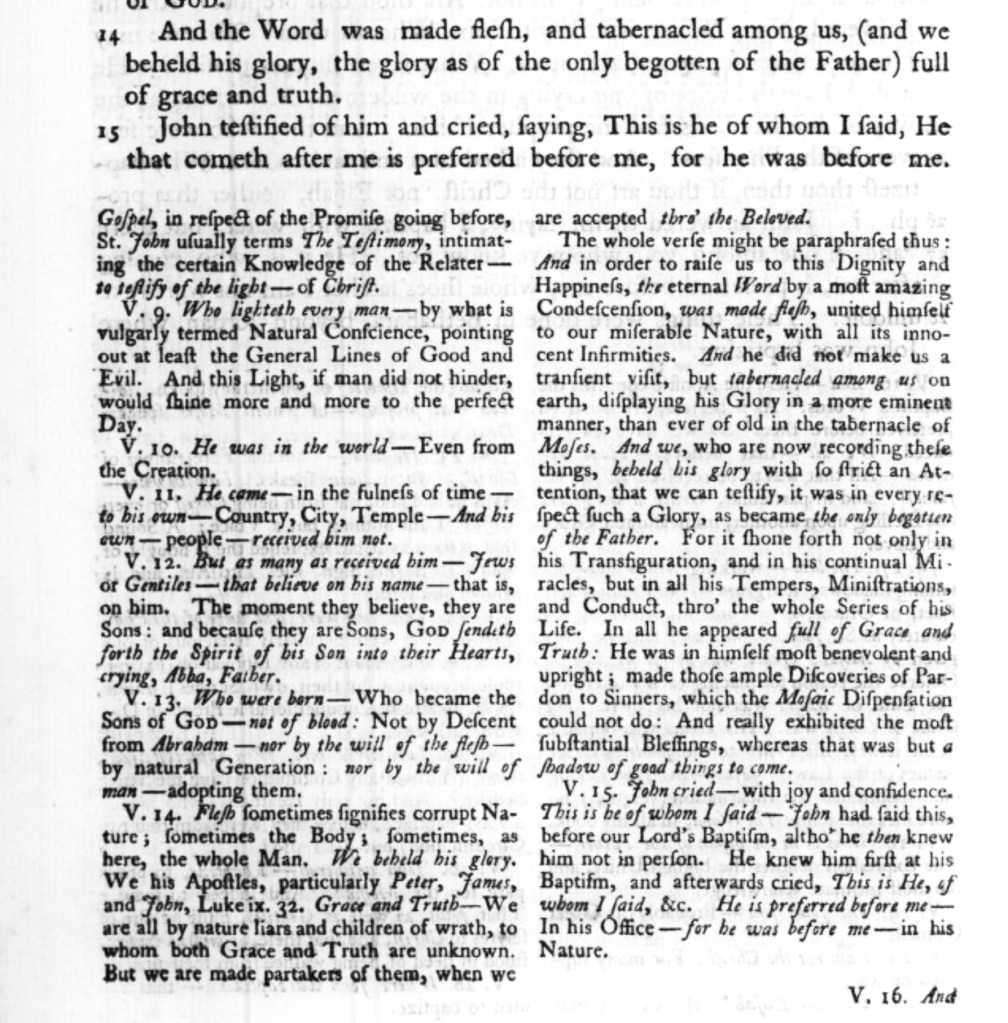
All this means that the RcV is the only widely read English Bible that prints in the text itself that the Word “tabernacled among us.”
Biblical Commentary Support
As it sometimes turns out, what all the scholars know and discuss at length in their commentaries, you would never guess from reading the most popular Bible translations. This disconnect has always puzzled me. It often means that the general public forms its judgments about Scripture without realizing what is common knowledge in theological circles. As a result, people sometimes raise eyebrows at ideas that are, in fact, well established. They become suspicious of legitimate insights, not because the insights are obscure, but because they were quietly edited out for the sake of “accessibility” or “readability.”
Whatever the reasons may be for most translators avoiding the word tabernacled in John 1:14, scholars consistently agree: this word is appropriate and significant.
Here are just a few examples, with varying emphases.
Bengel (1742)
Σκηνή, a tabernacle [tent]; whence σκηνόω [I tabernacle]: He dwelt as in a tabernacle [tent] with us; truly, but not long, giving us a view of [the opportunity of seeing] Himself… The Dweller was ὁ λόγος, the Word: the flesh was His tabernacle and temple.18
Raymond Brown (1966)
If the Word has become flesh, he has not ceased to be God. In 14b this is given expression in the verb skēnoun (“make a dwelling; pitch a tent”)… When the Prologue proclaims that the Word made his dwelling among men, we are being told that the flesh of Jesus Christ is the new localization of God’s presence on earth, and that Jesus is the replacement of the ancient Tabernacle.19
D.A. Carson (1991)
More literally translated, the Greek verb skēnoō means that the Word pitched his tabernacle… amongst us. For Greek-speaking Jews and other readers of the Greek Old Testament, the term would call to mind the skēnē, the tabernacle where God met with Israel before the temple was built.20
Craig Keener (2005)
Just as God “tabernacled” with his people in the wilderness, God’s Word tabernacled among the witnesses of the new exodus accomplished in Jesus… That the image of the Word tabernacling among his people would have found a home among John’s readers is suggested by the declaration of Sirach [24:8], which would have been well-known: “The one who created wisdom caused her tabernacle (σκηνήν) to rest; thus she was to dwell (κατασκήνωσον) in Jacob”… The allusion would make sense to John’s audience.21
John F. McHugh, (2009)
This verb and this noun, each occurring, with reference to God’s indwelling in the midst of Israel, for the first time in Exod 25, explain why John chose to write ἐσκήνωσεν; and they… disclose the full meaning of ἐσκήνωσεν. A medieval Latinist caught the OT allusions perfectly: et tabernaculavit in nobis [Concilium Armenorum, A.D. 1342].22
Edward W. Klink, (2016)
The term almost certainly was intended to arouse other associations. The unusual verb… is certainly intending to recall many older traditions of God’s presence dwelling with Israel. One tradition stands out as primary and formative (as well as logically prior): the Sinai/Mosaic covenant and wilderness traditions of the ark and tent… By alluding to such themes and traditions, John is declaring that the dwelling of God among his people has now occurred par excellence. The incarnation is both a fulfillment and a replacement: John proclaims Jesus as the fulfillment of patterns, prophecies, and traditions associated with the tabernacle and temple (both old and new). Yet the incarnation is an unprecedented newness.23
Conclusion
John’s choice of tabernacled in 1:14 is deliberate and theologically rich. Translating it literally preserves a key that unlocks the sweeping arc of God’s economy from the wilderness tent of Exodus to the holy city of Revelation. If we hope to plumb the depths of Scripture, we must be willing to preserve its precision, even when others find it too strange. As Barth knew, the strange new world of the Bible is waiting for us, if we just know how to read.
Thankfully, the Recovery Version has kept this word front and center in the text for the nourishment of everyday Christians. It is a translation that trusts its readers and honors the text.
- See Watchman Nee, CWWN 54:92-3. ↩︎
- Henry Alford, New Testament for English Readers, Vol. 1, Part 2, p. 460: “The word… properly is… ‘tabernacled’… The word is one technically used in Scripture to import the dwelling of God among men.” ↩︎
- Rev 21:3, DB Hart: I heard a loud voice from the throne saying, “Look: The tabernacle of God is with human beings, and he will tabernacle with them… ↩︎
- Hart has: “pitched a tent among us.” ↩︎
- G.B. Caird, Commentary on Revelation (Harper and Row, 1966), ad loc Rev 21:3, pp. 263-64. ↩︎
- RcV 1:14, note 2 ↩︎
- Ann Conway-Jones, Gregory of Nyssa’s Tabernacle Imagery in Its Jewish and Christian Contexts (Oxford, 2014), 98: “There are precedents for the tabernacle being interpreted as a type of the church, and for particular elements within it to be seen as symbols of Christ but not for the heavenly tabernacle as a whole to be construed as a type of Christ. Where, therefore, did Gregory get the idea?” Gregory makes this move in his Life of Moses 2.173-79 ↩︎
- Maximus the Confessor, Ambigua 61. ↩︎
- YLT: “And the Word became flesh, and did tabernacle among us…” ↩︎
- AMPC (1958): “And the Word (Christ) became flesh (human, incarnate) and tabernacled (fixed His tent of flesh, lived awhile) among us…” ↩︎
- OJB: “And the Dvar Hashem took on gufaniyut (corporeality) and made his sukkah, his Mishkan (Tabernacle) among us [YESHAYAH 7:14], and we [Shlichim, 1Y 1:1-2] gazed upon his Kavod [SHEMOT 33:18; 40:34; YESHAYAH 60:1-2], the Shechinah of the Ben Yachid from Elohim HaAv, full of Hashem’s Chesed v’Emes.” ↩︎
- EXB: “The Word became ·a human [T flesh] and ·lived [made his home; pitched his tabernacle; C God’s glorious presence dwelt in Israel’s tabernacle in the wilderness] among us…” ↩︎
- TLV: “And the Word became flesh and tabernacled among us….” ↩︎
- Bibliotheca: “And the Word became flesh, and tabernacled among us…” ↩︎
- For starters, see The Cambridge Companion to John Wesley (2009). ↩︎
- Hugh T. Kerr, Readings in Christian Thought, 2nd ed (1990), p ?. ↩︎
- Robert W. Wall, “Wesley as Biblical Interpreter,” The Cambridge Companion to John Wesley, ed. Randy L. Maddox and Jason E. Vickers (2009), 113-114. ↩︎
- Bengel, Gnomon Novi Testamenti, Vol. 2, ad loc. ↩︎
- Raymond Brown, The Gospel According to John, Anchor Yale Bible (1966), 32. ↩︎
- D.A. Carson, The Gospel According to John, Pillar NT Commentary (1991), 127. ↩︎
- Craig Keener, The Gospel of John: A Commentary, vol 1 (2005), 408-9. ↩︎
- John F. McHugh, John 1–4, ICC (2009), 56. ↩︎
- Edward W. Klink John, Zondervan Exegetical Commentary on the New Testament (2016), 108. ↩︎

 conversant faith
Beautiful. John using temple language to describe Christ. “Skenos” (σκηνόω) and “shekinah” (שכינה) share linguistic roots, derived from the Hebrew root “שכנ” (SKN), which means “to dwell” or “to inhabit.” Wesley was definitely onto this and no surprise given his understanding of theosis and sanctification.
LikeLiked by 2 people
Thanks for reading. Yes, this is a great point. SKN for both words, so cool.
If you read Wesley’s note at 1:14 it sounds like he weaves in theosis language right there! “We are all by nature liars and children of wrath, to whom both grace and truth are unknown. But we are made partakers of them, when we are accepted through the Beloved. The whole verse might be paraphrased thus: And in order to raise us to this dignity and happiness, the eternal Word, by a most amazing condescension, was made flesh, united himself to our miserable nature, with all its innocent infirmities.”
Great exchange is classic metaphor for deification.
Now read his note on 2 Pet 1:4 — “Ye may become partakers of the divine nature – Being renewed in the image of God, and having communion with them, so as to dwell in God and God in you.”
This is perichoresis.
LikeLike
I like the idea of producing and maintaining four types of Bible translations which serve for four different purposes:
Literal Equivalence.
Dynamic Equivalence.
Optimal Equivalence.
Paraphrase.
John 1:14 for example:
It is crucial to translate the verb into “to tabernacle”. This discloses a very important detail concerning this truth. And once we know it, understanding other parts of the Gospel of John becomes much easier.
Such a translation would be classified as “Literal Equivalence”.
On the other hand, imagine Billy Graham preaching to a full stadium.
Imagine he wants to read John 1:14 to mention that Christ came to us “full of grace and truth”.
I think that, in such a situation, a translation that uses the verb “tabernacling” is not the best.
I am afraid it would take the audience out of the preaching focus.
For this case, perhaps it would be better to use an “Optimal Equivalence” translation.
LikeLike
Thanks for the comment! Yes I agree that in preaching you have to take care of your audience. If it were me, I would probably first gloss it to accommodate them (“The Word has become what we are, just like you and me, he has come into our midst, he has made his dwelling among us, etc etc”), but then after that I see no problem in saying something like “And what John is actually saying here is that Jesus is new tabernacle, the dwelling place of God itself on earth, the place where we meet God, get to know God, experience God, and can come into God to experience all he is. Think about it: once you are inside a house, you get to experience all that’s there—the light, the AC, the couch, the food. Everything in the house is the reality of the house! My letting you in to enjoy it is grace. Jesus is just such a house, the only difference is that everything in the house that we get to enjoy is none other than GOD.”
To me this is more a matter of technique in preaching and communication than a cognitive obstacle with a technical translation. Besides, there are a lot of technical points in the Bible! But your point is well taken.
LikeLike
Pingback: Is Watchman Nee Anti-Intellectual? | conversant faith