
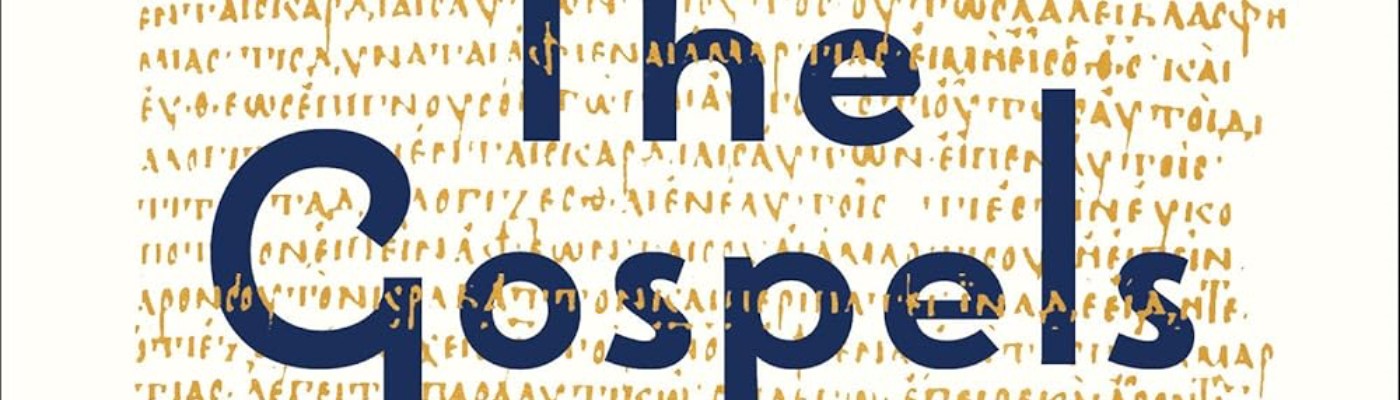


The following reprints a book review that I wrote for Theophron: Journal of Christian Studies in 2022.

Ruden, Sarah. The Gospels: A New Translation. New York: Modern Library, 2021. pp. lxviii, 333. $28.00 (hardcover). ISBN 978-0-3995-9294-2.
Sarah Ruden joins the growing ranks of Bible translators seeking to free the ancient text from theological accretions and linguistic mutations that later reshaped it into an abstruse tome of barely-readable English. Traduttore traditore (“the translator is a traitor”), as the saying goes, and Ruden claims that the story of Christianity’s origins has been so poorly ‘traditioned’ that much of its original meaning, vitality, and humor has been obscured. She works like an archeologist unearthing a mosaic, delicately brushing individual words with her classical training to excavate and restore them to their original brilliance. The Gospels: A New Translation is her attempt to recover the stylistic strangeness of the Gospel and reestablish the crucial “nexus of content and style” (xxxv). At the heart of her project is an appeal to Christians to consider well the world that their words create.
Ruden has already produced a spate of highly acclaimed classical translations, most notably Vergil’s Aeneid (2008) and Augustine’s Confessions (2017). The other Greek translations in her oeuvre—Homeric hymns, bawdy comedies, and philosophical dialogues—demonstrate her versatility in multiple genres and the range of considerations that inform her approach to the Gospels. She is steeped in antiquity’s ethos and thought patterns and is keen to discern how a first-century audience would have heard the telling of this startling good news.
In a bold move that captures the mood and daring of her project, Ruden prefaces her Gospels with an excerpt from Virginia Woolf ’s novel To the Lighthouse. The quote signals the goal of her eclectic translation—to “read in the littered pieces the clear words of truth”—and conditions the reader to enter Ruden’s work thinking about how the Gospels and secular literature interface and mutually inform one another (ix).
A substantial introduction chronicles her account of how things went wrong. Ruden rehearses a rather standard critical account of the Gospels, including their anonymous authorship, impossible harmony, jumbled linguistic pedigree (a Koinē Greek rendering of Aramaic dialogue that quotes a liberal Greek translation of a Hebrew text), and error-propagating transmission process. She addresses what she considers to be the authors’ fanciful appropriation of Hebrew “prophecy,” misunderstandings of idiom (e.g., Son of Man, Son of God), and ultimate baptism of the text into imperial Latin. When the text finally emerged in English in its long-influential, “authorized” form, it no longer breathed the freedom and freshness of the original. Ruden may have slightly overplayed her hand here. At one point, she claims that the word theology “did not exist until many generations after the latest Gospel,” while in fact, Plato used the word 400 years before the earliest Gospel (xxxii).
The second part of the introduction outlines Ruden’s translation methodology and goals. She strives for a rendering of the text that is jarring and vivid. This is where Ruden excels. She produces an “estranging translation” as a defense against “anachronism, obfuscation, and lethargy, which drain communications of their primordial electricity” (xxxix-xl). One way she does this is by transliterating important proper names. So for instance, the Farisaioi and Saddoukaioi come from Hierosoluma; the holy family flees into Aiguptos to preserve Iēsous’ life from Hērōdēs. In addition, the translation attempts to convey the generic quality that certain words had in the minds of ordinary people by adopting a “lowercase understanding” of these words (xxxiii). It is unsettling to discover the ambiguities this approach brings to terms like “god.”
Another strategy Ruden employs is deconstructing stock theological terms into their basic sense, as suggested by ancient lexicons. A lengthy glossary spells out the rationale behind the more significant choices. In actual context, these choices become very effective in destabilizing familiarity. A few examples demonstrate this well. “At the inauguration was the true account, and this true account was with god, and god was the true account” (John 1:1). “If someone wants to come along behind me, he needs to renounce all claim to himself and lift up day by day the stake he’ll be hung on and follow me” (Luke 9:23). “Didn’t I choose the twelve of you myself ? But among you, one is a slanderer” (John 6:70). These examples, in turn, baffle, horrify, and demythologize; they preclude inattentive reading that drowses with assumptions.
When it comes to a vivid reading experience, Ruden displays her genius as a translator and poet by constantly discovering felicitous ways to enliven the text. Instead of “disciples” and “scribes,” terms thick with religiosity, Ruden gives us “students” and “scholars.” Instead of the stuffy “wise and foolish virgins,” we read of the Austenian-sounding “silly and sensible girls.” Ruden follows the Greek text like a tango partner—closely but with her own artistic flourishes (in another book, she speaks of Koinē Greek’s “propensity for dance-ability”). In the bizarre story of the possessed hogs drowned in the sea, instead of a traditional rendering (“rushed down the steep bank into the sea, and were drowned in the sea,” NRSV), Ruden has, “barreled down the crag into the sea, and in the sea they drowned” (Mark 5:13). Here, there is no difference in meaning, but Ruden has replaced the flat report with a vivid, rhythmic line that is pure delight on the tongue. In the shorter ending of Mark, Ruden describes the women “bolting out of the tomb, convulsed and out of their minds with shock” (16:8). There are plenty of colloquialisms, too. Throughout Luke (and only in Luke), the disciples frequently call Jesus “Boss.” In John, when Pilate presents Jesus to the crowd, instead of the dramatic “Behold the man,” Ruden gives us the mocking “Look at this guy.” Moves like this pervade her text.
The translation is complemented by an appropriate amount of short footnotes beneath the text. Ruden plays to her strengths here, and the effect is refreshing. The notes mainly elucidate linguistic features of the Greek, provide background on the Greco-Roman social world, and point out correspondences to classical literature.
Readers familiar with the sprawling array of Bible translations will detect similarities to other solo-translator projects. Ruden combines the informal style of J. B. Phillips, the classical training of Richmond Lattimore, and the destabilizing aim of David Bentley Hart. A comparison with Hart’s much-discussed translation reveals just how successful Ruden’s work is, especially since they share many of the same goals. The difference is that Hart is a theologian while Ruden is admittedly not, and this fact works out to her advantage here. It will be interesting to see how successful she is in the epistles, where narrative, parable, and dialogue give way to doctrine and theological vocabulary. If she completes the entire New Testament, it would be great fun to pair hers with Robert Alter’s literary translation of the Hebrew Bible (2018).
Ruden’s work will be helpful both to those seeking a contemporary literary translation and those who keep slipping into autopilot with an overfamiliar text. Readers will invariably come away with a richer sense of the Gospels’ strangeness, verve, and sheer delightfulness. They will be reminded that the first people to hear the “good news” did so with none of the Christian filters that we have adopted. Ruden underscores the text’s essentially anti-docetic quality—the real fleshliness of the text that is so quickly suppressed in the interest of dogma—and wants us to read it, enjoy it, and wrestle with it as it really is. Ruden would say, “This is the true account, tolle lege.”

 conversant faith
Thanks for this. I enjoyed the review and will definitely get a copy of Ruden’s translation. This appeals to me very much. Mark Jordan
LikeLike
Kyle, thanks for sharing that article. Very interesting. Not sure what I think about not capitalizing “God”, but I guess that does shake one up. I do agree that it is possible to lapse into familiarity and, for this year’s Bible reading, I am using the Amplified Version for just that reason — throw a couple of curve balls that will keep me engaged with the text. Of course, the real key is to muse/meditate on the Word of God and take it in as life and as food. Thanks very much.David W. Vinson, M.D.
LikeLiked by 1 person
Yes, I wouldn’t use this as a normal version, more of a supplement or a curiosity even. There are plenty of other versions good for getting out of ruts. David Bentley Hart, JB Philips, New Jerusalem Bible, Ronald Knox, Richmond Lattimore, CSB.
LikeLike
I’ve always felt Wuest’s version gave me a good shake up and reset in my reading of the New Testament.
LikeLike
Hadn’t heard of this version so will have a look at it. Saw you mention Latttimore and remembered mentioning that to you several years ago. What did you think about his version? Wonder how this new version compares with the Unvarnished New Testament by Andy Gaus. One of several on my shelves, yet to be read. But from what I remember, it sounds like he shares a similar aim with Ruden. It is good to see women getting into the translation game. I am still looking for a copy (electronic is all I could afford) of the Julia E. Smith Parker translation. To my understanding and wiki’s the only woman to translate the entire Bible to date.
LikeLike