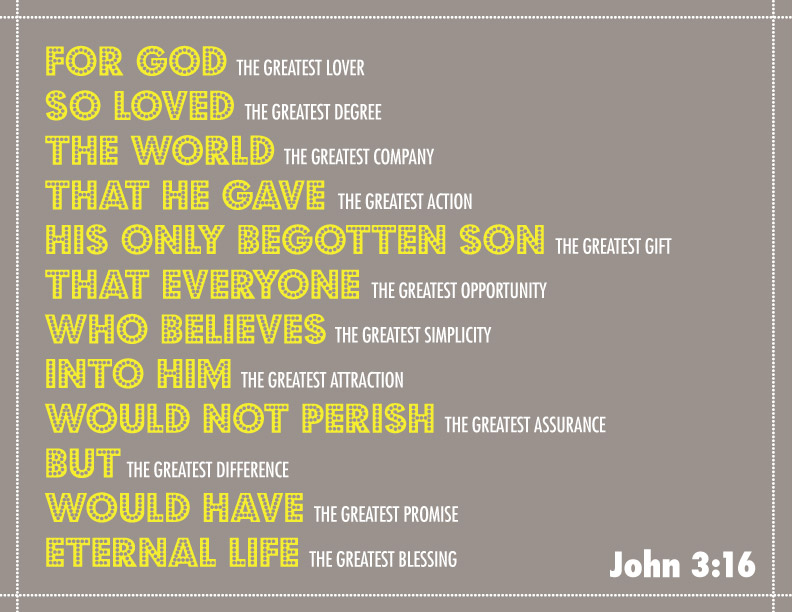
John 3:16, properly understood, may be one of the greatest verses in the Bible.


One, two, three, four… five? 
How many gospels are there?
This depends on a number of things. Primarily, what is the gospel? Who is it for? What does the message of good news include?
Of course traditionally we refer to Matthew, Mark, Luke, and John as the four gospels. But Paul seems to consider his message in the book of Romans as the gospel too, although in another sense.
Paul, a slave of Christ Jesus, a called apostle, separated unto the gospel of God –Rom. 1:1
This is how Paul kicks off this epistle- invoking the gospel of God as the raison d’être of his ministry. Now I know what you’ll say, this is not conclusive evidence to claim that Romans is a so-called fifth gospel (nevermind the spurious or apocryphal gospels). But look closely at verse 15:
So, for my part, I am ready to announce the gospel to you also who are in Rome.
The question is, who is the you here? Verse 7 makes it abundantly clear:
To all who are in Rome, beloved of God, the called saints: Grace to you and peace from God our Father and the Lord Jesus Christ.
Paul is saying that he is ready to announce the gospel to already believing Christians in Rome! Paul is saying that even the Christians need the gospel. Not in a New Calvinist kind of way, but the gospel in its entirety with its proper focus.
The most basic definition of the gospel is the good news. The traditional four Gospels are packed with good news. That good news however is largely focused on man’s benefit—his salvation, rescue from eternal damnation, and restoration to a proper humanity. This is certainly good news. But this is admittedly shy of God’s eternal purpose.
Thus, Paul in Romans lets us know that there is much more good news. This is ultimately good news to God, because in the working out of this gospel God is the principal beneficiary.
For if we, being enemies, were reconciled to God through the death of His Son, much more we will be saved in His life, having been reconciled. –Rom. 5:10
The four Gospels all end with “the death of His Son” resulting in our reconciliation to God and with His subsequent resurrection as the receipt or proof our justification (Rom 4:25). They zoom in on the three and a half years of Christ’s life and ministry on earth which culminated in the cross. They are four distinct but harmonious biographies of the God-man Jesus.
But Paul is here to tell us that there is something “much more.” This implies that if you don’t know this gospel, Paul’s gospel, than you know much less than the totality of the good news.
The gospel in Romans concerns God’s purpose (Rom 8:28-29), God’s will (Rom 12:2), and God’s mysterious economy (Rom 16:25, Eph 3:9).
God’s purpose is to produce many glorified sons that Christ might be the Firstborn among many brothers. God’s will is to obtain the Body of Christ with many members. God’s economy is to mysteriously work Himself in Christ as the Spirit of life into the spirit, soul, and body of His believers for His manifold expression.
Actually the word gospel shows up more times in Romans than in any other book in the New Testament (totaling 9 times as a noun, a few more as a verb including verse 15 above).
In this sense then, Romans is the fifth gospel.
The gospel of God is an all-inclusive unveiling of God’s full counsel concerning His good pleasure, His will, His purpose, and His economy. This is presented to humanity as a proclamation, as an official announcement made by a herald who has the responsibility to proclaim under official sanction this tremendous announcement.
-Ron Kangas, Crystallization-Study of the Gospel of God
The gospel is good news for God in that through it His eternal purpose to gain the Body of Christ and the kingdom of God is realized and His enemy Satan is crushed (Rom 12:5, 14:17, 16:20).
Next time you are out preaching the gospel then, and someone says, “Oh yes, I’m already a Christian” why not do what Paul did and announce the gospel anyway, for God’s sake?

Do not think that I have come to abolish the law or the prophets; I have not come to abolish, but to fulfill. –Matt. 5:17
For Christ is the end of the law unto righteousness to everyone who believes. –Rom. 10:4
Some have argued against the very first line of Jefferson Bethke’s Why I Hate Religion, but Love Jesus, and since it is the premise of the whole video it needs careful attention. Matthew 5:17 seems to lean one way on this issue while Romans 10:4 seems to lean the other way. These two verses are not contradictory. Since Bethke doesn’t define religion explicitly it’s left to everyone else to extrapolate. Although, the context makes it somewhat obvious what he is getting at.


At 10,587,270 views at 11 pm on only the fifth day since it was posted, the “Why I Hate Religion, But Love Jesus” YouTube video can officially be dubbed viral.
It’s amazing to me that 685 words with the right video editing and some perfectly timed musical swells can attract such a flash flood of attention. The entire video lasts but a brief 4 minutes and 4 seconds.
For counterpoint:
Martin Luther’s 95 Theses was 2,633 words and were nailed to the door of the Castle Church of Wittenberg. No lute was playing in the background for dramatic effect.
The United States Declaration of Independence was 1,458 words.
Proust’s In Search of Lost Time, the third longest novel in Latin or Cyrillic alphabets, stands at 1.5 million words and is today creating considerably less a stir. Apparently then, length does not necessarily equal impact. The internet is a different kind of physics.
In fact, it’s very probable that if Jefferson Bethke’s video had been much longer, many people wouldn’t have watched it to the end. But the visual stimulus and moving music appealed to more than just the “relevant” followers of Jesus.
Beyond the appeal to the senses there is the more significant appeal to reason, history, and the Bible.
The thesis sentence seems to be “Jesus came to abolish religion.”
Notable themes are: judgmentalism, self-righteousness, objective teachings that don’t transform, mere rule-following, hypocrisy, works and self-merit. Jesus and the apostles surely touched on all these themes in the New Testament (Matthew 7:1, Romans 2:1, 21-23, 2 Corinthians 3:6, Matthew 15:7-8, Galatians 2:16)
In the deluge of blog responses and their comments, some have come to the defense of religion. Clearly we need some definition of religion in mind then to proceed.
My working definition of religion comes from Witness Lee and is “the attempt to do something for God apart from Christ.”
Thus, not only is legalism religion but loving people apart from Christ is religion. Zealous works apart from Christ is religion. Patience apart from Christ is religion. Kindness apart from Christ is religion. Anything that is not the result of the subjective experience of Christ living in you may very well be religion.
Galatians is a book that combats religion, and here Paul uses such expressions as “reveal His son in me” (Gal. 1:15-16), “Christ who lives in me” (Gal. 2:20), and “until Christ is formed in you” (Gal. 4:19).
In this sense, Jesus did not come to abolish one religion (Judaism) to establish another religion (Christianity). Christ came to release His divine life into His believers to form the church as His organic Body for His practical, corporate expression. This is His eternal purpose and it is absolutely outside religion.
Let us therefore go forth unto Him outside the camp… –Hebrews 13:13
To trace the history of the children of Israel is a lesson in religion. It’s beyond the scope of this post but it’s an enlightening survey- how man went from direct fellowship with God, to indirect fellowship (yet still genuine and in faith) with God through the tabernacle with the offerings and the priesthood, to (generally) degraded traditionalism without much heart for God. What began as a vital contacting of God in faith ultimately became a religion of man.
The synagogue itself became the epicenter of the persecution that Jesus and the apostles experienced.
And departing from there, He came into their synagogue. And behold, a man who had a withered hand was there. And they asked Him, saying, Is it lawful to heal on the Sabbath? so that they might accuse Him. And He said to them, What man will there be among you who will have one sheep, and if it falls into a pit on the Sabbath, will not take hold of it and lift it out? Of how much more value then is a man than a sheep! So then it is lawful to do well on the Sabbath. Then He said to the man, Stretch out your hand. And he stretched it out and it was restored, as sound as the other. But the Pharisees, going out, took counsel against Him as to how they might destroy Him. –Matthew 12:9-14
And all in the synagogue were filled with anger when they heard these things, and they rose up and cast Him out of the city and led Him to the brow of the hill on which their city was built so that they might throw Him down the cliff. –Luke 4:28-29
His parents said these things because they feared the Jews, for the Jews had already agreed that if anyone confessed Him to be the Christ, he should be put out of the synagogue. –John 9:22
And beware of men, for they will deliver you up to sanhedrins, and in their synagogues they will scourge you. –Matthew 10:17
Ultimately Judaism became formal in letter, deadening in quenching the Spirit, killing in man’s communication with God in life, and contending with the gospel of Christ in God’s New Testament economy. If it happened with Judaism in the Old Testament could it happen with segments of Christianity in the New Testament?
What should we do about it then? What do you want to change? Do you want people to do more to reach out to the homeless? Do you want people to be more tolerant and accepting of others? Do you just want people to unwind a little and not be such sticklers? These may all be good things. But the only thing that can save us from religion is the subjective experience of Christ as life.


The law is subtle. It’s the carrot dangling in front of the donkey.
The law itself is not the problem. We are.


This post developed out of a comment I left on Kevin DeYoung’s recent post on Why Lewis Loved the Law.



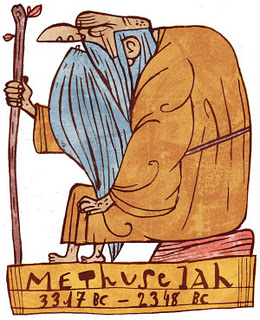 There is a dynamic interplay in the story of Noah that has intrigued me recently.
Methuselah’s age as recorded in the Bible has become the stuff of trivia, factoid, debate. But have you ever wondered why he was the one who lived the longest?
Methuselah’s name is significant. It means, “when he dies, it will be sent.” The it, of course, being the flood. This means that Noah wasn’t the only one to get the revelation concerning the destiny of the world. His great grandfather Enoch did too. Once Enoch saw this revelation, he began to walk with God.
It has the power to radically alter our life habits, to the point where our friends may wonder if we are the same person as before.
Noah in a sense inherited the revelations of the godly men before him. Noah was born into something that was already set in motion by God. He came on the scene right in the midst of it. Then God came in and revealed the situation to him and also the way of salvation.
That must have been a decisive moment in his life. The impact of the revelation must have been staggering. To put it in Watchman Nee’s words, he saw “a world under water.” How could he live the same? In a sense, that moment defined him. His life could be dived by the before and after. This revelation produced a deep inward realization about everything.

We’re all guilty of doing it.
It’s easy to reduce God to a magic eight ball.
As we approach crossroads in life, we remember, “Oh yeah, I’ve got God.” So we ask our question, shake really hard, and optimistically turn our magic 8 ball over.
Don’t reduce God to a computational machine.
But you may say, “What about knowing God’s will for me? What about knowing what I’m supposed to do? What school to go to? Who to marry?” These are all legitimate concerns no doubt. But they are not all there is to God.

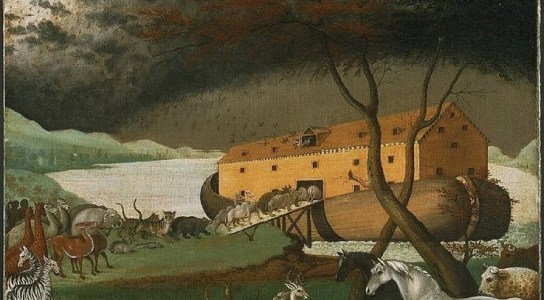
Recently I’ve been considering the mission of the church from the lens of Noah’s life and work.
Jesus Himself reveals how relevant the story of Noah is today.
For just as the days of Noah were, so will the coming of the Son of Man be. –Matt. 24:37
Noah’s living and work parallels and prefigures the critical aspects of the church’s mission in view of Christ’s return.



If John 3:16 is the most famous verse in the New Testament, what some have endearingly called the “end zone gospel”, then the verses of Psalm 23 must be the Old Testament equivalent.
With soldiers, guidance counselors, and everyone dealing with difficult situations of loss or discouragement, this chapter surely has been flipped to.
Psalm 23 presents Christ as the Shepherd. What could be more comforting? In this Psalm there are 18 personal statements- my Shepherd, I will lack nothing, He makes me lie down, etc.
We will never graduate from our need of Christ’s personal shepherding. Jacob’s life testifies of this- near his end he recognized God as the One who had shepherded him his whole life (Gen. 48:15). Even for eternity the Lamb will shepherd us to springs of water of life (Rev. 7:17).
But eventually our Christian life needs to turn to shepherding others.

 Of all the books of the Bible, none other tops the Hot 100 chart more consistently than Psalms.
The Psalms are inspiring, poignant, prophetic, and personal. They span history, prophecy, and theology in one swoop. They reveal both the height of divine majesty and the depth of human depravity. They’re used for prayer, praise, meditation, and devotion.
But what are they all about?


