



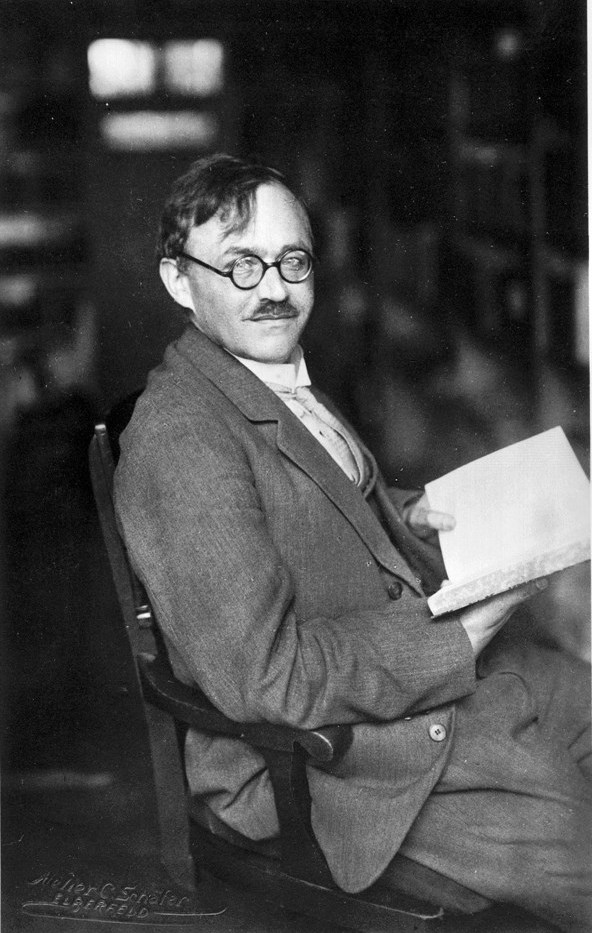
How did I go to Princeton Theological Seminary, take two classes on Barth, do a Church Dogmatics reading group at night with Hunsinger, get a letter from Reichel, help McCormack move out of his office AND YET had never heard of this poem till yesterday?!
Admittedly, this captures only one aspect of Barth’s theological profile. Still, it’s an incredible poem, and I love having found a poem devoted to Barth. For a partial analysis of the poem and how Barth differs from the poem in his later theology see this article by Iwan Russell-Jones.
On The Death of Karl Barth
He ascended from a lonely crag in winter,
His thunder fading in the Alpine dusk;
And a blizzard was back on the Church,
A convenient cloak, sprinkling harlot and husk –
Back again, after all his labour
To clear the passes, give us access
Once more to the old prophetic tongues,
Peak-heats in which man, time, progress
Are lost in reconciliation
With outcast and angered Deity.
He has not gone silenced in defeat:
The suffocating swirl of heresy
Confirms the law he taught us; we keep the glow,
Knowing the season, the rhythm, the consummation.
Truth predicts the eclipse of truth,
And in that eclipse it condemns man,
Whose self-love with its useful schools of thought,
Its pious camouflage of a God within,
Is always the cause of the shadow, the fall, the burial,
The smug rub of hands
Amid a reek of research.
The cyclic, well-meant smothering
Of the accursed footprints inside man’s frontier;
The militant revival,
Within time and as an unchanged creed,
Of the eternal form and substance of the Word:
This has marked Western history,
Its life’s chief need and counter-need,
From the hour God’s feet shook Jordan.
We touched His crag of paradox
Through our tempestuous leader, now dead,
Who ploughed from Safenwil to show us greatness
In a God lonely, exiled, homeless in our sphere,
Since his footfall breeds guilt, stirs dread
Of a love fire-tongued, cleaving our sin,
Retrieving the soul from racial evolution,
Giving it grace to mortify,
In deeps or shallows, all projections of the divine.
Jack Clemo, “On the Death of Karl Barth,” The Echoing Tip (1971), 54.

 conversant faith